
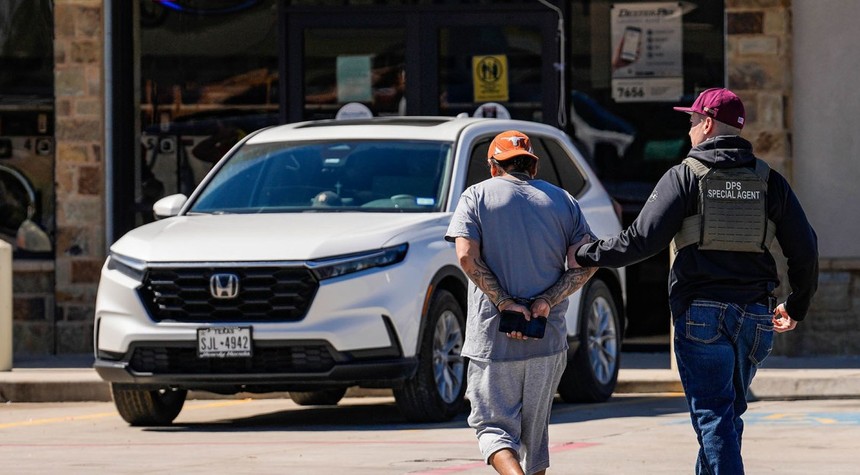
The facts are simple. The Dallas Police Chief refused to cooperate with Immigration and Customs Enforcement. Meanwhile, Houston has seen a 1000% increase in calls to ICE since President Trump’s re-election. This is not complicated, yet somehow it has become a political quagmire for law enforcement agencies across Texas.
Let us be clear about what is happening here. The Trump administration is requesting assistance from local law enforcement to remove criminal illegal immigrants from American communities. This is not a radical proposition. This is basic governance. The Department of Homeland Security has explicitly stated its focus: murderers, gang members, rapists, terrorists, and pedophiles. These are not sympathetic figures. These are dangerous criminals who should not be in this country.
Dallas Police Chief Daniel Comeaux declined to assist ICE when asked months ago. His reasoning remains unclear, but the implications are straightforward. By refusing cooperation, Dallas has essentially told federal immigration authorities that they will need to handle enforcement operations alone in the third-largest city in Texas.
Houston presents a different picture entirely. Despite having no formal agreement with ICE, the city’s police department has dramatically increased its communication with federal immigration authorities. According to public records, calls from Houston police to ICE have skyrocketed 1000% since Trump’s re-election, predominantly resulting from traffic stops. Houston Mayor John Whitmire, a Democrat, acknowledged this cooperation and has faced substantial criticism from residents and officials for doing so.
This creates an interesting dynamic. A Democratic mayor in Texas’ largest city is facing backlash for cooperating with federal immigration enforcement, while a police chief in a Republican-dominated city refuses to participate. The political calculations are obvious, but they miss the fundamental point: public safety should transcend partisan politics.
The Trump administration has made its position abundantly clear. Cities that refuse cooperation will see ICE, Border Patrol, or National Guard troops deployed to their streets regardless. Chicago, Los Angeles, and Charlotte chose non-cooperation and subsequently witnessed federal immigration enforcement operations in their communities anyway. The choice for local officials is not whether immigration enforcement will occur, but whether they will have any input in how it happens.
Texas Republican lawmakers have attempted to resolve this issue through legislation. State law now requires sheriffs’ offices in counties with populations exceeding 100,000 to sign agreements with ICE by December 2026. The Texas Department of Public Safety has already signed such an agreement. This represents a logical approach: if local officials refuse to make decisions, state officials will make those decisions for them.
The Migration Policy Institute reports that law enforcement departments nationwide are signing partnership agreements with ICE at unprecedented speed. Cities including Las Vegas and Miami have joined this decades-old program. Yet remarkably, none of the police departments in America’s top ten largest cities have signed on as ICE partners, according to the agency’s official list. Houston, Dallas, and San Antonio all appear on that list of non-participants.
The federal government is offering financial incentives to local and state law enforcement agencies that partner with ICE. Many cities are declining these funds along with the partnerships. This is their prerogative, but it represents a choice with consequences.
The question is not whether immigration law will be enforced. The question is whether local law enforcement will participate in that enforcement or watch federal agents operate independently in their jurisdictions. That is the choice facing Texas cities and municipalities nationwide.
Related: Secretary Hegseth Spends Thanksgiving With Deployed Sailors Fighting Narco-Terror Networks