
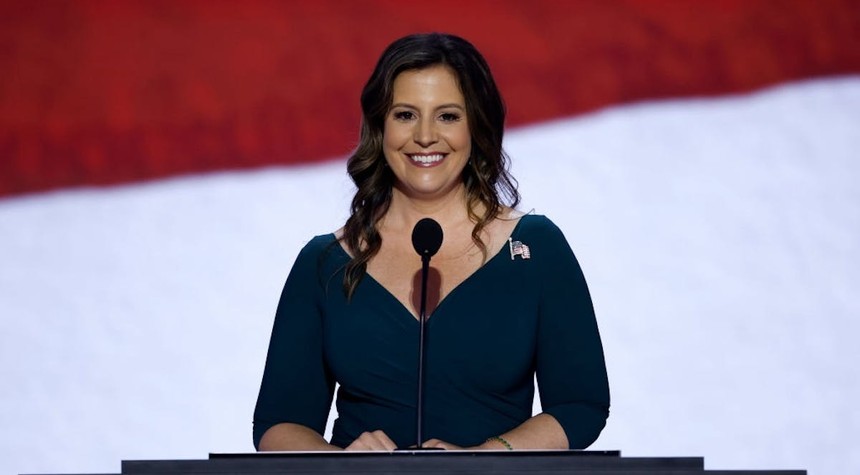
Rep. Elise Stefanik announced Friday that she is suspending her campaign for New York governor and will not seek re-election to Congress, a stunning decision that removes one of the Republican Party’s most prominent voices from electoral politics.
The facts are straightforward. Stefanik, who had positioned herself as the strongest Republican challenger to Democratic Governor Kathy Hochul, cited the entry of Nassau County Executive Bruce Blakeman into the GOP primary as the catalyst for her withdrawal. In a statement posted on X, Stefanik explained that spending time with family during the Christmas season led her to reassess the political landscape and conclude that a primary battle would constitute an inefficient allocation of resources.
Here is where the situation becomes particularly noteworthy. Blakeman entered the race despite receiving a phone call from President Trump explicitly warning him against challenging Stefanik. Trump had endorsed Stefanik emphatically earlier this year, making Blakeman’s decision to proceed a direct defiance of the former president’s wishes.
Stefanik acknowledged in her statement that her campaign would have “overwhelmingly won” the primary. This assessment is likely accurate given her national profile, fundraising capabilities, and Trump’s endorsement. However, she argued that engaging in “an unnecessary and protracted Republican primary” in a state as politically challenging as New York would not constitute an effective use of time or donor resources during the first half of the year.
The logic here is sound from a purely strategic standpoint. New York remains a deeply blue state where Republicans face structural disadvantages in statewide races. A bruising primary would deplete financial resources and create intraparty divisions that would only benefit Hochul in the general election. Stefanik evidently calculated that the probability of ultimate success did not justify the expenditure of political capital required to navigate both a contested primary and a general election in hostile territory.
What makes this development particularly significant is Stefanik’s decision to exit Congress entirely rather than simply abandon the gubernatorial race and retain her House seat. This represents a complete withdrawal from electoral politics, at least for the immediate future. Stefanik has been a rising star in Republican circles, serving as House Republican Conference Chair and establishing herself as one of Trump’s most vocal defenders during both impeachment proceedings.
The broader implications for New York Republicans are concerning. Without Stefanik in the race, the party loses its most formidable potential challenger to Hochul. Blakeman’s decision to enter despite Trump’s opposition raises questions about party unity and discipline heading into what will already be a difficult election cycle in New York.
The situation also highlights a persistent challenge for Republicans in blue states: the difficulty of recruiting and maintaining strong statewide candidates when the electoral mathematics remain unfavorable and primary challenges can emerge even against Trump-endorsed candidates. Whether Stefanik’s withdrawal represents a temporary pause or a permanent exit from politics remains to be seen, but her absence leaves a significant void in New York’s Republican leadership at a critical moment.
Related: House Republicans Demand Accountability Before Lifting Syria Sanctions