The Trump administration has released its National Security Strategy document, and the message is clear: deterring Chinese aggression against Taiwan requires overwhelming military superiority and allies who actually pull their weight.
The document, released Friday, represents the administration’s first comprehensive strategy statement since Trump took office in January. The timing is significant. Beijing just conducted its largest maritime show of force to date, deploying vessels across East Asian waters while ratcheting up pressure on both democratically governed Taiwan and Japan.
“Deterring a conflict over Taiwan, ideally by preserving military overmatch, is a priority,” the document states plainly. This is not diplomatic hedging. This is strategic clarity.
The facts are straightforward. China views Taiwan as its own territory and has never renounced using force to seize control of the island. Beijing also claims almost the entire South China Sea, despite objections from numerous smaller neighbors who have their own legitimate territorial claims. The Chinese Communist Party does not respect international law when it conflicts with their expansionist ambitions.
The new strategy document represents a marked departure from previous administrations’ approach. Trump’s 2017 National Security Strategy mentioned Taiwan three times in a single sentence, using standard diplomatic language. The updated version mentions Taiwan eight times across three paragraphs and directly addresses why the island matters strategically.
The reasoning is sound. Taiwan sits in trade-rich waters at a critical geographic chokepoint. More importantly, Taiwan dominates semiconductor manufacturing, producing the advanced chips that power everything from smartphones to military systems. Allowing China to control Taiwan would hand Beijing leverage over the global economy and American national security.
The document commits to building “a military capable of denying aggression anywhere” along the island chain stretching from Japan to Southeast Asia. This is the language of deterrence through strength, the only approach Beijing respects.
But here is where the strategy gets interesting and necessary. The document explicitly states that “the American military cannot, and should not have to, do this alone. Our allies must step up and spend – and more importantly do – much more for collective defense.”
This is exactly right. For decades, American allies have freeloaded on U.S. military power while failing to meet their own defense commitments. Japan, South Korea, and other regional partners benefit enormously from American security guarantees but have not invested proportionally in their own defense capabilities.
The strategy aims to reinforce “U.S. and allies’ capacity to deny any attempt to seize Taiwan” or take other actions that would “make defending that island impossible.” This requires allies who actually contribute meaningful military capability, not just diplomatic statements.
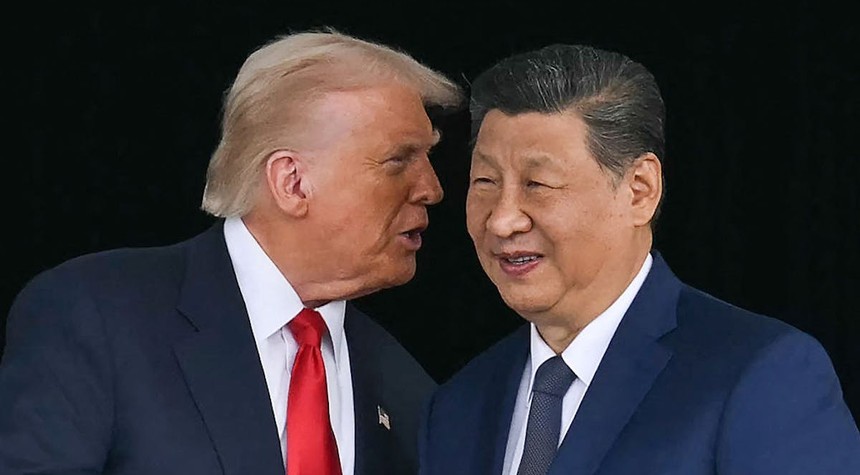
Trump’s approach has generated predictable anxiety among some regional partners. His dealmaking style and efforts to establish working relationships with Chinese President Xi Jinping have sparked fears of weakening American support for Taiwan and regional allies. Trump plans to travel to Beijing in April to discuss extending the trade war truce.
These concerns miss the point. Deterring conflict requires both military strength and diplomatic engagement. The strategy document makes clear that military overmatch remains the priority. Talking to Xi does not preclude preparing to counter Chinese aggression.
The United States has no formal diplomatic ties with Taiwan, but Washington serves as the island’s most important international backer. American law requires providing Taiwan with defensive capabilities. This has irritated Beijing for years. Good. Strategic ambiguity served its purpose for decades, but the current environment demands strategic clarity about American interests and capabilities.
The question now is whether allies will heed the call to increase their defense contributions or continue expecting American taxpayers to shoulder the burden alone.
Related: Minnesota Governor Faces Mounting Scrutiny Over Delayed Response to Massive COVID Fraud Scheme