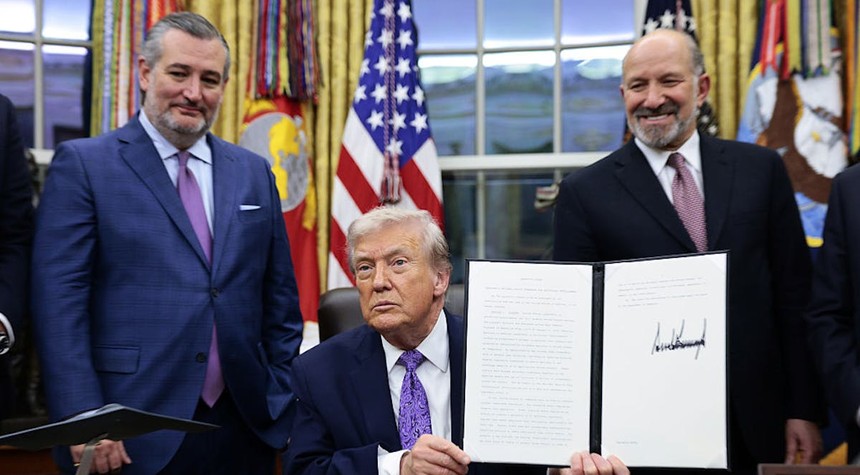
President Donald Trump signed an executive order Thursday aimed at dismantling what his administration characterizes as excessive state-level artificial intelligence regulations, establishing instead a unified national framework designed to keep America competitive against China in the technology race.
The facts are straightforward. More than 1,000 AI-related bills have been introduced across state legislatures, creating what the administration correctly identifies as a regulatory nightmare for American companies. The executive order directs federal agencies to challenge what it terms “onerous and excessive” state AI regulations while developing a coherent national standard.
“One of the things it has is you have to have a central source of approval. When they need approval of things, you have to come to one source; they can’t go to California, New York, and various other places,” Trump stated during the signing.
The logic here is sound. A patchwork of 50 different regulatory regimes does not foster innovation. It stifles it. Startups and established companies alike cannot reasonably navigate contradictory requirements across state lines while simultaneously competing against Chinese firms operating under a unified national strategy.
The executive order makes several key points worth examining. First, it establishes an AI litigation task force specifically tasked with challenging state laws deemed overly burdensome. Second, it directs Commerce Secretary Howard Lutnick to evaluate all existing state AI laws. Third, it proposes restrictions on federal funding for states that enact certain policies contrary to the national framework.
The administration’s concerns extend beyond mere regulatory efficiency. The order explicitly addresses states embedding ideological bias into AI models and unconstitutionally regulating interstate commerce. These are legitimate constitutional questions that deserve serious consideration.
“To win, United States AI companies must be free to innovate without cumbersome regulation. But excessive State regulation thwarts this imperative,” the executive order states plainly.
The framework Trump envisions includes protections for children, prevention of censorship, respect for copyrights, and community safeguards. AI czar David Sacks clarified that the administration would not challenge state laws focused on child safety, indicating the order targets regulatory overreach rather than legitimate protective measures.
The timing matters. China has made artificial intelligence development a national priority, pouring resources into AI research while American companies navigate conflicting state regulations. This represents a fundamental competitive disadvantage that cannot be ignored simply because some prefer state-level control over federal standardization.
The constitutional question of interstate commerce regulation is not trivial. When California or New York implements AI regulations that effectively control how companies operate nationwide, they are arguably exceeding their constitutional authority. The Commerce Clause exists precisely to prevent such state-by-state fragmentation of national markets.
Senator Ted Cruz, Treasury Secretary Scott Bessent, and Commerce Secretary Lutnick attended the signing, underscoring the administration’s commitment to this initiative. This follows Trump’s previous executive order establishing the “Genesis Mission,” focused on integrating AI into research and accelerating scientific discovery.
The broader question remains whether America will maintain its technological edge or cede ground to authoritarian competitors unburdened by regulatory chaos. The answer requires decisive action, and this executive order represents exactly that approach.
Related: Newsom Administration Mocks Musk Over Estranged Child in Escalating Public Feud