
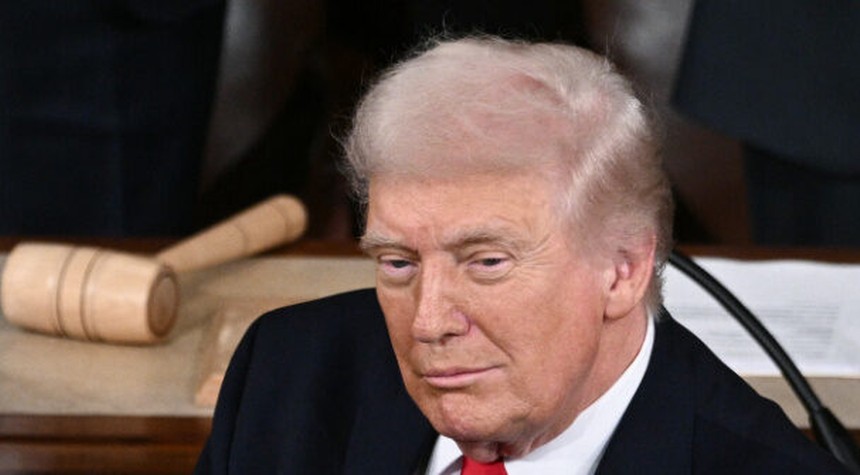
President Donald Trump delivered a bold economic vision during Tuesday’s State of the Union address, proposing that tariff revenue from foreign nations could eventually replace the federal income tax system entirely.
The proposal represents a fundamental reimagining of how the federal government funds itself, harkening back to the pre-1913 era when tariffs, rather than income taxes, provided the primary source of federal revenue. The facts here are straightforward: before the ratification of the Sixteenth Amendment in 1913, the United States government operated primarily on tariff revenue and excise taxes. Trump is proposing nothing less than a return to that constitutional framework.
“Countries that were ripping us off for decades are now paying us hundreds of billions of dollars,” Trump declared to assembled lawmakers and guests. “They were ripping us off so badly, you all know that, everybody knows it, Democrats know it, they just don’t want to say it.”
The president’s assertion rests on a simple economic premise: if foreign nations and corporations pay substantial tariffs to access American markets, those revenues could theoretically offset or eliminate the need for income taxation on American citizens. Whether this calculation works mathematically depends entirely on the scale of tariff revenue generated versus current income tax receipts, which totaled approximately $2.2 trillion in fiscal year 2023.
Trump acknowledged the Supreme Court’s recent decision striking down his emergency tariffs, calling it “very unfortunate.” However, he expressed confidence that foreign nations would maintain existing agreements rather than risk potentially harsher terms. “The good news is that almost all countries and corporations want to keep the deal that they already made, knowing that the legal power that I, as President, have to make a new deal could be far worse for them,” Trump explained.
The president further credited his tariff strategy with facilitating peace negotiations. “Many of the wars I settled was because of the threat of tariffs. I wouldn’t have been able to settle them without,” he stated, positioning trade policy as a critical tool of diplomatic leverage.
The economic logic here deserves examination. Tariffs function as consumption taxes paid by importers, which typically get passed along to consumers through higher prices. Income taxes directly reduce take-home pay. The question becomes whether Americans would prefer higher prices on foreign goods versus direct taxation on their earnings. For many conservatives, the answer is obvious: taxation represents government confiscation of earned income, while tariffs represent voluntary market transactions.
Critics will undoubtedly argue that tariffs amount to hidden taxation and could spark trade wars. These concerns are not without merit, but they ignore a fundamental reality: the current system already burdens American workers while allowing foreign competitors to operate under advantageous terms. The president’s approach seeks to rebalance this equation.
“As time goes by, I believe the tariffs paid for by foreign countries will, like in the past, substantially replace the modern-day system of income tax, taking a great financial burden off the people that I love,” Trump declared to thunderous applause.
Whether Congress will embrace this vision remains uncertain, but the proposal represents a serious attempt to restructure federal financing in a way that prioritizes American workers over foreign competitors. The debate over implementation will prove fascinating.
Related: When Enforcing the Law Becomes Terrorism According to House Democrats