
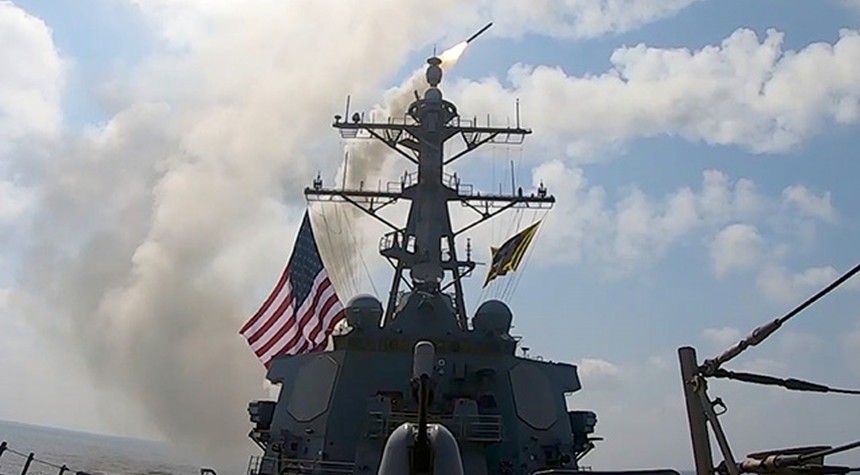
Two days. That’s all it took for the United States to reduce Iran’s naval presence in the Gulf of Oman from eleven warships to nothing. Not diminished. Not damaged. Zero.
U.S. Central Command made the announcement Monday with the kind of blunt clarity that cuts through decades of diplomatic hedging. Every Iranian vessel that was operating in those waters when Operation Epic Fury began on Saturday has been sent to the bottom. The ships included major surface combatants and support vessels that Tehran had used for years to harass commercial shipping, launch drones, and generally make life miserable for anyone trying to move goods through one of the world’s most critical waterways.
This wasn’t some limited strike package or a warning shot across the bow. American forces hit more than 1,250 targets in the first 48 hours alone. We’re talking B-2 stealth bombers, F-35 fighter jets, MQ-9 Reaper drones, and naval strike platforms working in concert across multiple theaters. The target list read like a greatest hits album of Iranian military infrastructure: Islamic Revolutionary Guard Corps headquarters, command and control centers, ballistic missile production facilities, launch sites, anti-ship missile facilities, air defense systems, submarines, and communications infrastructure.
President Trump put it plainly when he said U.S. forces are “annihilating their navy” and destroying Iran’s missile capabilities “hourly.” That’s not campaign rhetoric. That’s an operational update.
The Gulf of Oman matters because it connects the Arabian Sea to the Strait of Hormuz, and roughly one-fifth of the world’s oil supply moves through that corridor. For decades, Iran has treated these waters like its personal playground, harassing commercial vessels, seizing tankers, and threatening to choke off global energy supplies whenever it suited Tehran’s purposes. The regime used the implicit threat of disruption as leverage, knowing the international community would bend over backwards to avoid confrontation in such a sensitive area.
Those days just ended.
CENTCOM released video footage showing precision strikes hitting docked Iranian vessels and shoreline naval infrastructure. The imagery tells you everything you need to know about American military capabilities when the gloves come off. This is what happens when decades of restraint give way to decisive action.
The naval campaign didn’t happen in isolation. Operation Epic Fury opened over the weekend with coordinated U.S. and Israeli strikes that eliminated at least 48 senior Iranian officials, including former Supreme Leader Ali Khamenei. Israeli intelligence officials later described it as a carefully timed strike launched while senior leadership was gathered in one location, a rare convergence that allowed multiple high-value targets to be taken out simultaneously. It was surgical, devastating, and frankly the kind of operational planning that should terrify anyone who threatens American interests or our allies.
What we’re witnessing is the dismantling of Iran’s ability to project power beyond its borders. Not containment. Not deterrence. Dismantling. There’s a difference, and it matters. For years, the prevailing wisdom in Washington was that we needed to manage the Iranian threat, negotiate with it, contain it through a combination of sanctions and diplomatic pressure. That approach assumed Tehran was a rational actor that would respond to incentives and pressure in predictable ways.
The problem with that theory? It gave Iran decades to build up asymmetric capabilities designed specifically to exploit American reluctance to engage directly. The regime invested heavily in proxy forces, drone technology, ballistic missiles, and naval harassment tactics because they calculated, correctly, that previous administrations would tolerate a certain level of provocation rather than risk broader conflict.
This administration made a different calculation. When you destroy a nation’s entire naval presence in a strategic waterway in 48 hours, you’re sending an unmistakable message about what America is willing and able to do when its interests and the global economic order are threatened. Freedom of maritime navigation has underpinned American and global prosperity for more than 80 years, as CENTCOM noted, and the United States just demonstrated it will defend that principle with overwhelming force when necessary.
The speed and scope of these operations should also put other adversaries on notice. This wasn’t a months-long buildup with clear telegraphing of intentions. This was rapid, decisive, and comprehensive. The kind of military action that reshapes facts on the ground before diplomatic channels can even convene an emergency session.
Iran spent decades building a navy designed to threaten international shipping. That navy no longer exists in the Gulf of Oman. The regime’s senior leadership has been decimated. Its missile infrastructure is being destroyed hourly. And the world just watched it happen in real time. That’s the new reality, and honestly, it’s about time someone had the spine to establish it.
Related: The Iranian Terror Threat Democrats Ignored Is Already Inside America