
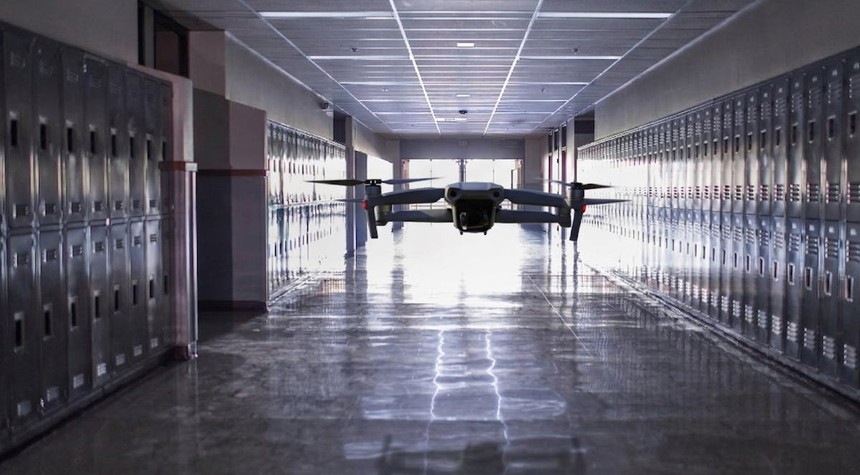
There’s something profoundly American about solving a problem everyone else just wrings their hands over. While politicians debate gun control for the thousandth time and school boards install yet another metal detector that makes everyone feel safer without actually being safer, a few districts in Florida and Georgia decided to do something that sounds like science fiction but makes perfect sense. They’re putting armed drones in schools.
The system is called Campus Guardian Angel, built by a company named Mithril Defense. The name alone tells you these folks understand what they’re building. In Tolkien’s world, mithril was the unbreakable metal that protected Frodo. Here, it’s pepper gel dispensing drones called Black Arrows that can hit 100 miles per hour and hunt down an active shooter before the first patrol car even leaves the station.
You know what’s remarkable? This isn’t some government committee’s idea that took fifteen years and three billion dollars to implement. This is private innovation meeting desperate need. The drones sit ready in schools, and when a threat gets reported, trained pilots in Austin, Texas take control remotely. Within seconds, multiple drones deploy. They transmit live footage to operators and law enforcement simultaneously. They emit disorienting lights and sounds. They spray pepper gel that sticks and incapacitates. If necessary, they ram the shooter.
“We can take every corner, we’ll swing every door first, because we don’t care if we get shot, we’re metal and plastic,” said Christian Van Sloun, Mithril’s chief drone pilot. That’s the kind of blunt pragmatism we need more of. No hand wringing about feelings or optics. Just cold hard logic about what works.
Captain Todd Smith from Florida’s Volusia County Sheriff’s Office called it revolutionary. He’s right. This is the future, whether it makes people uncomfortable or not. More than half a million dollars has been allocated for drone deployment across Florida and Georgia districts. Deltona High School in Florida is getting its installation right now.
The response time difference matters more than anything else. Active shooter situations are measured in seconds. Every moment counts. Traditional response means calling 911, waiting for dispatch, waiting for officers to arrive, waiting for them to locate the threat. That’s minutes, sometimes many minutes. These drones cut that to seconds. They’re already inside the building. They’re already moving.
Some parents are nervous, which is understandable. Jessica Clayton, a parent in the program, admitted feeling nerve-racked at first. But she gets it. “You have to start somewhere, and I’m hoping this can be a positive influence for the community.” That’s the attitude that built this country. Not paralysis in the face of fear, but cautious willingness to try something new when the old ways clearly aren’t working.
The broader question here is about how we protect our kids. We’ve tried gun free zone signs. We’ve tried active shooter drills that traumatize children. We’ve tried armed resource officers who may or may not be in the right place when something happens. We’ve installed cameras that record tragedies but don’t prevent them. None of it has been enough.
Mithril co-founder Billy Marston has an ambitious vision. He wants these systems in every school in America. He believes they can eradicate mass shootings. That might sound grandiose, but consider the logic. If every potential shooter knows that armed drones will be hunting them within seconds of the first shot, some will reconsider. Others who don’t reconsider will be stopped faster. Either way, fewer kids die.
This is what limited government and free market innovation looks like when it works. Government couldn’t solve this problem, so private citizens did. They risked their own capital, developed their own technology, and offered it to communities desperate for real solutions. That’s the American way. Not waiting for Washington to save us, but saving ourselves.
The technology raises questions about privacy and oversight, sure. Those conversations matter. But they shouldn’t paralyze us into inaction while children remain vulnerable. We can implement safeguards. We can establish protocols. We can ensure these systems are used appropriately. What we can’t do is nothing.
Related: Thirteen Dead Americans and Virginia Democrats Still Won’t Call ICE