
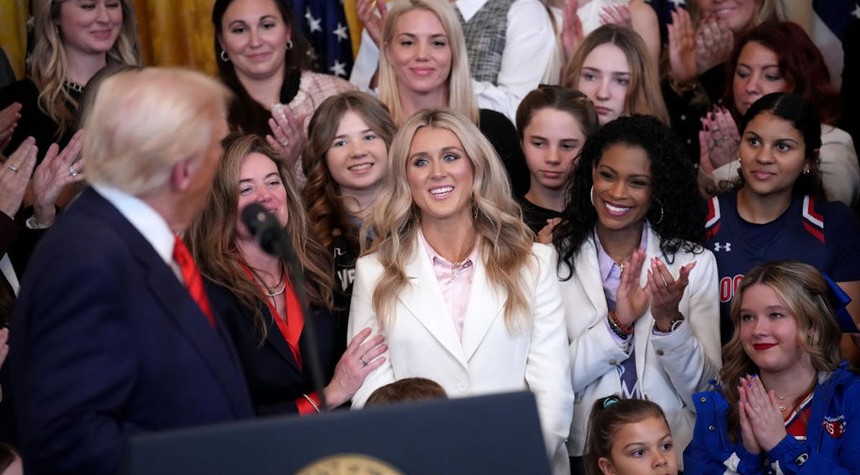
The Supreme Court did something remarkable on Tuesday. It acknowledged reality.
In a landmark decision authored by Justice Brett Kavanaugh, the Court ruled that states have the constitutional authority to ban biological males from competing in women’s sports. The decision upheld laws in Idaho and West Virginia, and by extension, validated similar protections enacted by more than half the states in this country. It’s a straightforward ruling grounded in common sense, which apparently makes it revolutionary in 2025.
Justice Kavanaugh’s opinion cut through years of ideological fog with refreshing clarity. “They may determine eligibility for women’s and girls’ sports based on biological sex,” he wrote. “The Constitution and Title IX do not require an overhaul of women’s and girls’ sports throughout America.” That second sentence deserves repeating because it captures the absurdity of where we’ve been. We were genuinely debating whether the entire structure of women’s athletics needed dismantling to accommodate a political movement that can’t distinguish between compassion and capitulation.
The conservative justices formed the majority, while the liberal wing offered a more fractured response. Justices Sotomayor, Kagan, and Jackson agreed with portions of the ruling but dissented on others, which tells you something about how even the left struggles to maintain ideological consistency when biology enters the conversation. You can only bend reality so far before it snaps back.
This ruling represents vindication for countless female athletes who’ve watched their opportunities, their records, and their safety compromised in the name of inclusion. Real inclusion, the kind that matters, doesn’t sacrifice one group’s rights to validate another’s feelings. It finds balance. It acknowledges trade-offs. It operates in the realm of the actual rather than the aspirational.
The decision also marks a significant win for the Trump administration, which issued an executive order in February addressing this exact issue. Say what you will about Trump’s style, but his administration recognized early that protecting women’s sports wasn’t controversial outside progressive echo chambers. Most Americans, regardless of political affiliation, understand that biological males possess inherent physical advantages that make competition fundamentally unfair when they’re placed in women’s categories.
What’s striking about this ruling is what it doesn’t do. The Court explicitly left for another day whether Title IX actually requires states to ban transgender athletes from women’s sports. This wasn’t judicial overreach. This was restraint. The justices simply affirmed that states have the power to make these determinations themselves, which is precisely how federalism is supposed to function. Different communities can establish different standards, and the Constitution doesn’t mandate uniformity on every social question that emerges.
The transgender movement has suffered multiple setbacks recently, and this ruling represents perhaps the most significant judicial rebuke yet. But here’s what activists refuse to acknowledge: protecting women’s sports isn’t an attack on transgender individuals. It’s a recognition that rights sometimes conflict, and when they do, we need frameworks for resolution that don’t pretend biology is negotiable.
Title IX was created to ensure women had equal opportunities in education and athletics. The law recognized that women deserved their own spaces, their own competitions, their own chance to excel without being overshadowed by male physical advantages. Twisting Title IX to mean the opposite of its original intent represents the kind of linguistic gymnastics that erode public trust in institutions.
This decision matters beyond sports. It signals that courts are willing to prioritize material reality over ideological pressure. It suggests that the pendulum might be swinging back toward sanity on questions of sex and gender. And it reminds us that sometimes the most radical act is simply refusing to pretend that obvious truths are somehow bigoted.
Female athletes can now compete knowing that their achievements won’t be diminished by competitors with male physiology. Scholarships will go to biological women. Records will reflect actual female performance. And young girls will grow up understanding that their sex-based rights still matter in American law.
That’s not transphobia. That’s justice.
Related: The FTC Firing That Just Rewrote Presidential Power for Good