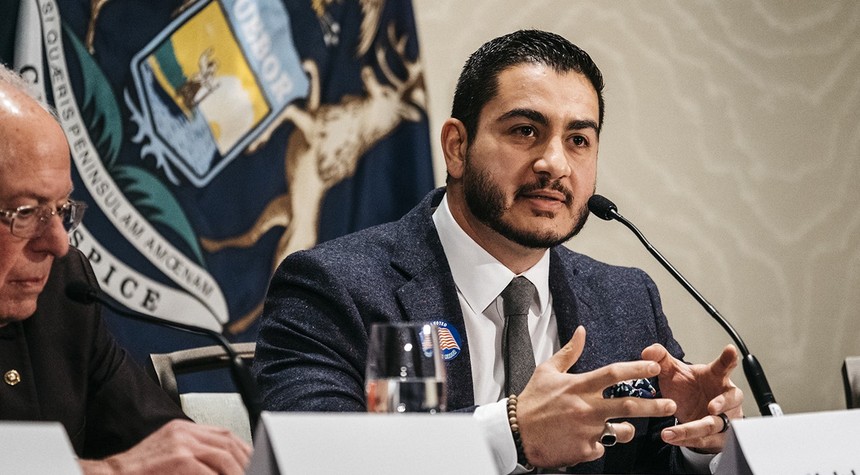
Michigan Democratic Senate nominee Abdul El-Sayed just said the quiet part out loud, and honestly, we should thank him for it. While most progressives dance around their actual policy goals with carefully workshopped language, El-Sayed told a left-wing podcast he wants to go even further than Bernie Sanders when it comes to government control of private artificial intelligence companies. Not just public ownership, mind you. He wants “public control” too.
Let that sink in for a moment. We’re talking about a Senate candidate who looked at Bernie Sanders’ socialist proposals and thought, you know what, that’s not enough. This is the same Bernie Sanders who honeymooned in the Soviet Union and has spent decades pushing America toward European-style socialism. And El-Sayed wants to take it further.
The timing here is almost comical. Just days before El-Sayed’s podcast appearance, a top House Democrat was busy assuring everyone that young socialists aren’t really talking about “seizing the means of production.” It’s just rhetoric, they said. Nobody actually wants government takeovers of private industry. Well, here comes Abdul El-Sayed with receipts proving otherwise.
During his June 12 appearance on the “Head in the Office” podcast, El-Sayed laid out his vision with remarkable clarity. He supports public ownership of major AI companies, sure, but he also envisions “some system of public control” that could include government representatives sitting on corporate boards or some kind of oversight body with real authority. He’s essentially describing a corporatist model where private companies exist in name only while bureaucrats and politicians pull the strings.
This matters because artificial intelligence represents one of the most dynamic and innovative sectors in the American economy. These companies are developing technologies that will shape the next century. They’re competing globally against China and other authoritarian regimes that already exercise total control over their tech sectors. And El-Sayed’s brilliant solution is to hamstring American companies with government control?
The free market works precisely because it rewards innovation and punishes failure without political interference. When government gets involved in picking winners and losers, we end up with Solyndra-style disasters and crony capitalism. Imagine federal bureaucrats, who can barely manage the DMV, making strategic decisions about cutting-edge AI development. It’s absurd on its face.
What’s particularly galling is the paternalistic assumption underlying El-Sayed’s position. He apparently believes that entrepreneurs, investors, and private citizens can’t be trusted to develop AI responsibly. Only enlightened government officials possess the wisdom and foresight to guide these companies. Never mind that government moves at a glacial pace while technology evolves daily. Never mind that political appointees serve two to four year terms while building transformational technology requires decades of consistent vision.
This isn’t about reasonable regulation or safety standards. Every industry needs some guardrails. This is about fundamental control over private enterprise, about politicians and bureaucrats having veto power over business decisions, strategic direction, and resource allocation. It’s the kind of central planning that failed spectacularly throughout the twentieth century, leaving economic wreckage and human misery in its wake.
El-Sayed’s candor actually serves a useful purpose. It clarifies what’s really at stake in these elections. Voters deserve to know that when progressives talk about “stakeholder capitalism” or “democratic control of industry,” they mean government control. They mean your tax dollars funding political appointees who sit on corporate boards and second-guess every decision. They mean innovation slowed to the pace of congressional committee meetings.
The American experiment was founded on individual liberty and limited government. Our prosperity stems from free people making free choices in free markets. Abdul El-Sayed wants to fundamentally alter that arrangement, and he’s honest enough to say so. Voters should be equally honest in their response.
Related: Rep Brandon Gill Takes Aim at McKinsey Over Workplace Diversity Reports