
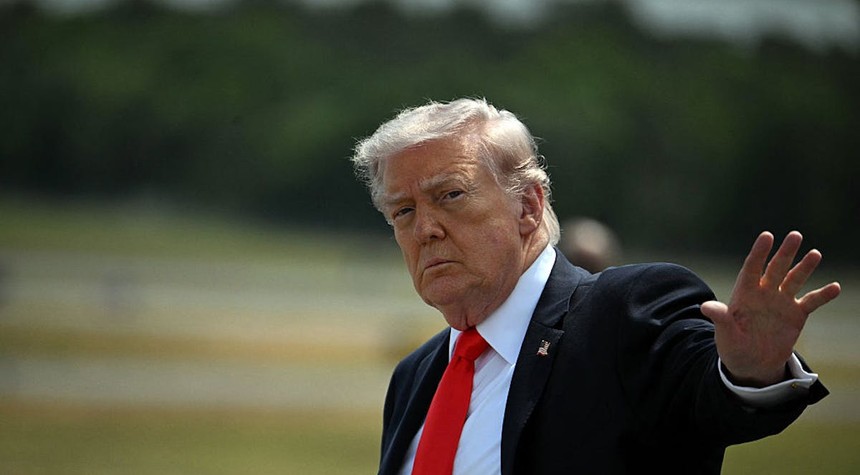
President Trump isn’t mincing words anymore. During a recent sit-down with Texas Lt. Governor Dan Patrick, he laid out a scenario that should terrify every conservative in America: the death of the Republican Party as a competitive force. And it all hinges on whether Republicans can pass the SAVE America Act before Democrats seize enough power to make elections unwinnable for anyone right of center.
The math is brutal and simple. If Democrats gain control and push through statehood for Puerto Rico and Washington D.C., they create four new Senate seats and up to six additional House members overnight. Trump pointed out what everyone knows but few politicians will say out loud: Republicans get about 3% of the vote in both places. That’s not a voting bloc. That’s a rounding error. It’s radical left territory through and through, and those new representatives would cement Democratic control for generations.
“I’ll be the last Republican president if that happens,” Trump said. Patrick didn’t dismiss it as exaggeration. He called it exactly what it is: reality. And here’s the thing that makes this doubly frustrating for anyone who values honest elections. This entire disaster is preventable. It’s what Trump calls an unforced error, which in political terms means Republicans would be fumbling the ball on their own five-yard line.
The SAVE America Act addresses what should be the most basic requirement of voting: proving you’re actually a citizen. We’re talking about photo identification and something as straightforward as showing where you were born. You need an ID to board a plane, cash a check, or buy certain cold medicines. But asking for proof of citizenship before someone helps choose the leader of the free world? Somehow that’s controversial in modern America.
Trump argues that far more Republicans would win if votes were limited to people who could verify they were born in the United States. That statement alone will make progressives lose their minds, but let’s be honest about what’s happening here. The left has spent years eroding election security under the guise of accessibility, as if requiring basic verification somehow disenfranchises legitimate voters. It’s nonsense wrapped in noble-sounding language.
The legislation also drastically limits mail-in balloting to people with actual legitimate needs: illness, disability, travel, or military service. Remember when absentee voting was reserved for people who genuinely couldn’t make it to the polls? Now we’ve normalized mass mail-in voting as if there’s no difference between showing up in person and having ballots floating around for weeks. The 2020 election should have taught us something about what happens when you abandon election security protocols in the name of convenience.
Republicans face a choice that’s almost too simple. Pass the SAVE Act and restore some semblance of election integrity, or watch as Democrats manufacture permanent majorities through demographic manipulation and lax voting standards. You don’t need to be a political scientist to see where this train is headed. Puerto Rico and D.C. statehood isn’t about representation. It’s about power, pure and simple.
The conservative vision of America—individual liberty, limited government, free markets, strong defense—doesn’t survive in a one-party state. And make no mistake, that’s where we’re heading if Republicans don’t get serious about election security right now. Trump’s warning isn’t alarmist. It’s a wake-up call that most of the GOP establishment is still hitting snooze on. How many more elections do conservatives need to lose before they realize the rules of the game have been rewritten against them?
This isn’t about Trump. It’s about whether Americans who believe in constitutional governance and traditional values will have any meaningful voice in their own country’s future. The SAVE America Act is imperfect like any legislation, but it addresses real problems that threaten the foundation of fair elections. Republicans either fight for it now or spend the next fifty years wondering why they can’t win anymore.
Related: Federal Film Tax Credits Could Save an Industry That Forgot How to Compete