
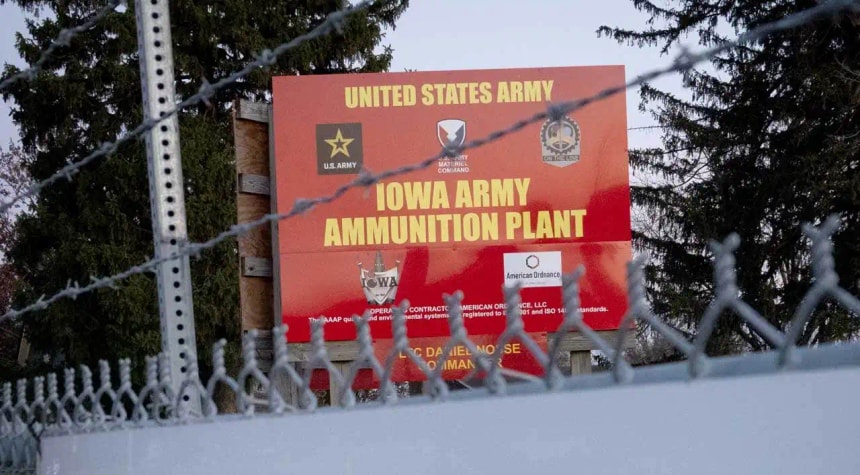
President Donald Trump announced Monday that he has ordered the military to halt plans for detonating degraded lead azide at the Iowa Army Ammunition Plant until both federal courts and incoming Democratic Governor Rob Sand approve the operation. The decision represents a significant departure from the Army’s assessment that immediate action is necessary to prevent a potentially catastrophic uncontrolled explosion.
The facts are straightforward. During a routine safety review in March, the Iowa Army Ammunition Plant discovered a stockpile of lead azide that had degraded and crystallized over time. Lead azide serves as a primary explosive in munitions detonators, but in its crystallized state, the material becomes extraordinarily sensitive to shock and friction. The Army’s environmental assessment makes clear that the degradation has transformed this material from a viable production component into hazardous waste that cannot be safely transported to standard demilitarization facilities.
The military’s position is based on expert analysis and years of study. According to the Army, the material presents an imminent danger of spontaneous detonation, a risk that increases as temperatures drop and the chemical continues to degrade. Acting Army Secretary Adam Telle initially scheduled the controlled detonation for Friday, then postponed it to Monday to avoid a temperature drop that could further destabilize the material. The Army delayed again until Wednesday to allow for optimal weather conditions and proper mitigation measures.
Here is where the situation becomes legally and politically complex. The U.S. Court of Appeals for the Eighth Circuit issued an administrative stay last Thursday blocking an emergency permit from the Environmental Protection Agency. Despite this judicial intervention, the Army informed the court Saturday that it planned to proceed with the detonation anyway, citing the need to protect the public from a more significant uncontrolled explosion.
Trump’s Monday intervention changes this calculus entirely. In a lengthy statement, the president acknowledged Iowa’s special significance to him politically while insisting his decision transcends electoral considerations. He traced the problem’s origins to 2009, when the Obama Administration allegedly improperly stored the explosives. Military experts who have studied the situation for years believe there is a substantial chance the material will explode spontaneously in the near future.
The controlled detonation would undoubtedly impact local communities. Army modeling predicts elevated lead particles in the air, though below levels requiring EPA protective actions. Residents in nearby Middletown would experience loud noise, ground vibrations from two rapid consecutive detonations, and a dust plume containing lead that could linger up to one hour depending on wind conditions.
Trump has now placed the decision squarely in the hands of the Eighth Circuit and Governor-elect Sand. His statement makes the accountability crystal clear. If Sand or the courts refuse to approve the operation, Trump declared, the incoming governor will bear responsibility for any death or destruction caused by this longstanding situation.
The president’s deference to local authority and judicial review demonstrates respect for federalism and the rule of law. However, it also creates a potentially dangerous stalemate. Military experts believe current weather conditions are optimal for the controlled operation. Delay increases the risk of spontaneous detonation, yet legal and political obstacles now prevent the Army from acting on its technical assessment.
This situation exemplifies the tension between bureaucratic process and urgent safety concerns. The Army possesses the expertise and responsibility to manage hazardous military materials. Courts exist to protect citizens from governmental overreach. Governors represent state interests against federal action. When these institutions conflict over an imminent safety threat, someone must make the final call. Trump has made his position clear while deferring to other authorities. The question now is whether Sand and the courts will accept the responsibility that comes with blocking the military’s recommended course of action.
Related: Viral Video of NYC Lawmaker Behind Mayor Mamdani Reignites Absurd Lizard People Theory