
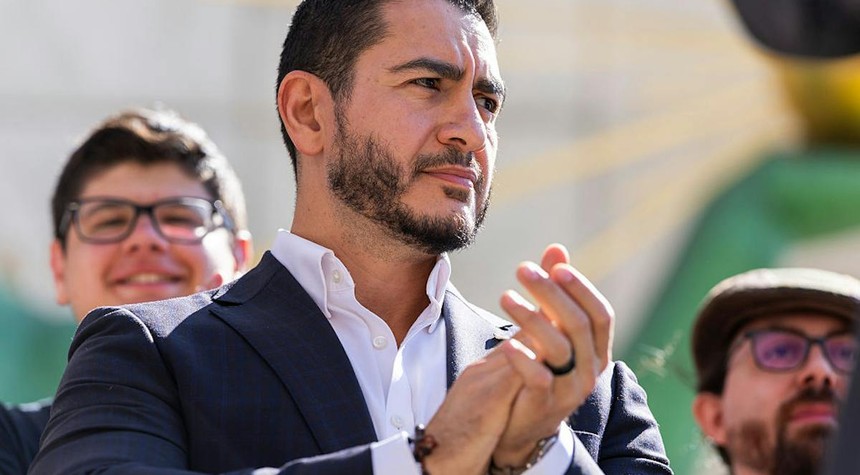
Watch a politician squirm when asked a straightforward question and you’ll learn everything you need to know about where they actually stand. Abdul El-Sayed, the Michigan Democrat running for U.S. Senate, just gave us a masterclass in evasion when Breaking Points host Saagar Enjeti asked him something remarkably simple: Would you support a universal healthcare plan that excluded gender transition treatments for minors?
The answer should take about five seconds. Yes or no. Maybe throw in a sentence of explanation if you’re feeling verbose. But El-Sayed couldn’t do it. He wouldn’t do it. Instead, he launched into a philosophical meditation on the purpose of government, wrapped himself in the language of individual rights, and accused anyone who dared ask the question of being more interested in denying healthcare than providing it.
Here’s what’s fascinating about this dodge. El-Sayed has been one of the loudest voices pushing for socialized medicine. He’s built his political brand on the promise of government-run healthcare for everyone. But when pressed on the specifics of what that system would cover, suddenly we’re talking about abstract principles and the specter of tyranny. It’s almost impressive how quickly he pivoted from policy specifics to moral grandstanding.
“Rights are rights are rights are rights,” El-Sayed declared, as if repeating the word four times makes his position clearer. He framed healthcare decisions as a matter between patients, doctors, and for minors, their parents. Government restrictions, he suggested, amount to tyranny. The irony here is thick enough to cut with a scalpel. This is a man advocating for the government to control the entire healthcare system while simultaneously arguing that government involvement in healthcare decisions constitutes oppression.
You know what’s missing from this equation? Common sense and the protection of children. We’re not talking about adults making decisions about their own bodies. We’re talking about minors, kids whose brains haven’t finished developing, who can’t legally drink or vote or sign a contract. But somehow we’re supposed to believe that irreversible medical interventions are just another healthcare choice, like getting your tonsils out.
Enjeti pressed him again, pointing out that he hadn’t answered the question. He noted that even some Democrats in Congress have stepped back from supporting these treatments for minors. Healthcare systems in Europe, places that progressives usually hold up as models, have started restricting these procedures after reviewing the evidence. But El-Sayed just doubled down on deflection.
His next move was even more telling. He tried to flip the script entirely, suggesting that Enjeti was more concerned about excluding people from healthcare than about making sure everyone had access to it. “You’re less concerned about whether or not people have healthcare and more concerned about whether or not some people are going to get healthcare,” El-Sayed said, his voice dripping with accusation. When Enjeti tried to clarify that he does want everyone to have healthcare, El-Sayed just talked over him.
This is the oldest trick in the activist playbook. When you can’t defend your position on the merits, attack the questioner’s motives. Paint anyone who disagrees as cruel, as obsessed with denying care, as fundamentally opposed to helping people. It’s intellectually dishonest and politically cowardly.
The question Enjeti asked cuts to the heart of what’s wrong with the progressive vision of healthcare. If the government controls the system, the government decides what gets covered. That means political fights over every single treatment, every drug, every procedure. El-Sayed wants the power that comes with government healthcare, but he doesn’t want to answer the hard questions about how that power would be used.
And make no mistake, this is about power. The activist class El-Sayed caters to has made gender ideology a litmus test. To question it, even slightly, even when it involves children, marks you as an enemy. So he can’t give a straight answer, because any answer that acknowledges reasonable limits would cost him politically with his base.
When Enjeti finally asked whether El-Sayed would serve all Michiganders or just the activist class, you could practically hear the gears grinding. El-Sayed retreated to his talking points about government protecting rights and fighting for basic needs. But he never did answer that original question about gender treatments for minors under universal healthcare.
The people of Michigan deserve better than this. They deserve candidates who can answer basic questions about policy without hiding behind rhetoric and accusation. If you want to run the healthcare system for an entire state, you better be able to explain what that system would look like in practice, not just in theory.
Related: The DOJ Just Weaponized Grand Juries Against California Election Workers