
Here are the facts: Republicans are winning the redistricting battle, and Democrats know it.
As both parties scramble to redraw congressional maps ahead of next year’s midterm elections, the numbers tell a clear story. Four states have already completed their redistricting processes—Texas, Missouri, North Carolina, and Ohio—and analysts project Republicans could gain up to nine seats from these redrawn maps alone. That is a significant advantage in a House where the GOP currently holds just a six-seat majority.
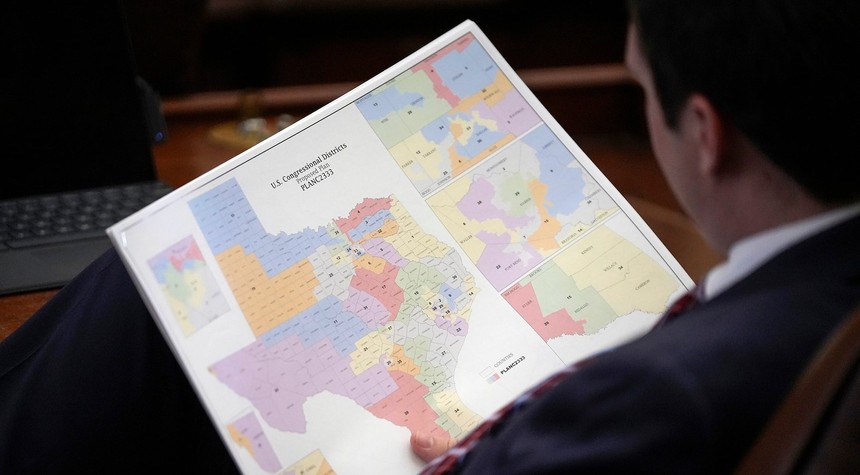
Let us be clear about what happened. Texas Republicans, acting on former President Donald Trump’s urging, passed a new congressional map in August that consolidated Democratic voters in urban and suburban areas while drawing new borders around Democratic seats to include more Trump voters. This is not some nefarious scheme—this is politics. When one party controls the state legislature, they use that power to their advantage. Democrats have done this for decades in states like Illinois and Maryland.
The Texas redistricting created five new Republican-leaning seats. Missouri and North Carolina each added one GOP-favoring district. Ohio, which was required to redraw its map due to state rules, passed what officials called a “compromise” map through a commission. That compromise still favors Republicans while keeping some districts competitive for Democrats—which means Republicans won on two fronts.
Democrats are not sitting idle. California voters are considering Proposition 50, a ballot initiative that would redraw five districts to lean more Democratic. The proposition’s supporters openly admit the goal is to counteract Texas’s redistricting. If it passes, Democrats hope to cancel out Republican gains. But here is the problem: even if California delivers, Democrats are still playing catch-up.
Several other states are considering mid-decade redistricting. Utah recently passed a new map following a court ruling, and it is currently under legal review. Democrats are cautiously optimistic about gaining one or two competitive seats there. Indiana’s Republican-controlled legislature is preparing to consider redistricting in a special session, while Virginia’s Democratic-controlled legislature is taking steps toward a new map. Republican-leaning states like Florida, Nebraska, Louisiana, and Kansas are exploring the option, as are Democratic strongholds like Maryland and Illinois.
The stakes could not be higher. Republicans currently hold 219 seats to Democrats’ 213, with three vacancies. Once those seats are filled, Democrats would need to flip just three seats to retake the House. Mid-decade redistricting fundamentally alters that calculation by changing which seats remain competitive.
This redistricting scramble reveals an uncomfortable truth for Democrats: they are losing ground in state legislatures where these decisions are made. Republicans control more state governments, which means they have more opportunities to redraw maps in their favor. This is the consequence of Democrats’ failures in state-level races over the past decade.
The Constitution mandates redistricting once per decade following the census. What we are witnessing now is unusual—multiple states redrawing maps mid-decade for various reasons, from court orders to political opportunity. Both parties are exploiting every available advantage, but Republicans are doing it more effectively.
The reality is simple: whoever controls the map-drawing process controls the political landscape. Republicans understood this after 2010 and invested heavily in state legislative races. Democrats are now paying the price for neglecting those races. If Democrats want to compete, they need to win state legislatures, not just complain about redistricting when Republicans do what Democrats have done for generations.
The redistricting battlefield will determine the congressional battlefield, and right now, Republicans are winning.
Related: American College Graduates Face Job Crisis While Foreign Workers Get Tax Advantages