
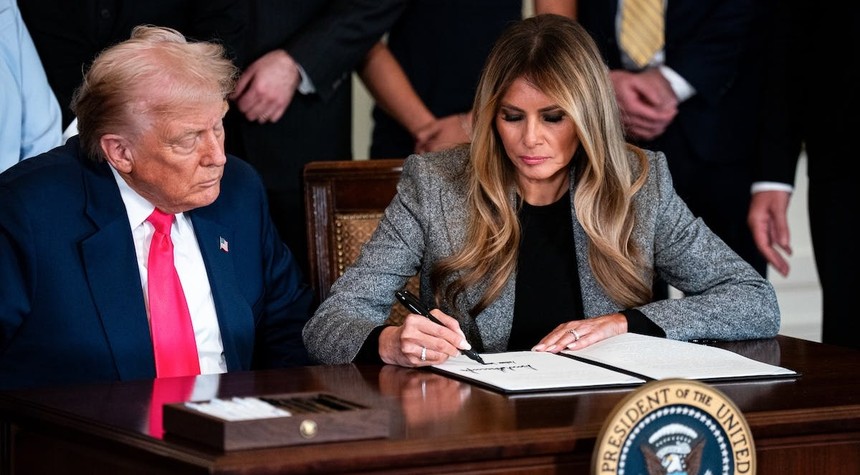
The Trump administration took decisive action Thursday to address a glaring problem in America’s foster care system: the alarming number of young adults who age out of the system and end up homeless or in dangerous circumstances on our streets.
President Donald Trump and First Lady Melania Trump jointly signed an executive order titled “Fostering the Future for American Children and Families,” marking a significant expansion of resources for teenagers navigating the transition out of foster care. The facts here are straightforward and sobering. According to data from the Health and Human Services Department, there are currently 328,947 children in the foster care system. Many of these young people face an uncertain future when they reach adulthood.
“Too many people from the foster care community end up homeless, in danger on America’s streets,” the First Lady stated before the signing. This is not hyperbole. It is a documented reality that demands attention and action.
The executive order builds upon Melania Trump’s Be Best initiative, which she began developing in 2021. The First Lady explained her vision clearly: “to provide individuals from the foster care community the ability to secure an entry-level job position, and in turn, financial independence.” This is the kind of practical, results-oriented approach that actually helps people rather than simply throwing money at a problem without accountability.
The specifics of the order demonstrate thoughtful policy construction. It will increase access to Education and Training Vouchers and federal grants specifically designed to support credentialed programs and financial literacy education for young people transitioning out of foster care. These are not vague promises but concrete mechanisms for providing real assistance.
Additionally, the order expands educational opportunities by facilitating state use of scholarship programs funded by tax-credited donations to scholarship-granting organizations specifically for children in foster care. This approach leverages private sector involvement while maintaining government support, a model that conservatives have long advocated as more efficient and effective than pure government bureaucracy.
The Fostering the Future initiative already offers scholarships at the university and college levels to individuals within the foster care community. This executive order scales up those efforts significantly.
President Trump framed the issue in moral terms during the signing ceremony. “We believe that every American child deserves a safe and loving home, and we’re determined to support the amazing families who helped make that happen,” he said. He then invoked biblical principles, noting, “The Bible tells us that one of the measures of any society is how it cares for vulnerable children and orphans. So important. And it’s so big in the Bible.”
This is fundamentally correct. A society’s character is indeed measured by how it treats its most vulnerable members. The question has always been about the most effective approach to providing that care.
The First Lady expressed optimism about the initiative’s potential impact: “I predict this small spark today will ignite a profound and lasting nationwide movement. Our united resolve will foster a thriving future filled with compassion and innovation.”
The proof will be in the results. But the framework established here, focusing on education, job training, and financial literacy rather than mere dependency, represents a serious attempt to address a genuine crisis affecting hundreds of thousands of American children.
Related: Trump Administration Targets Immigration Enforcement to Address Soaring Home Prices