
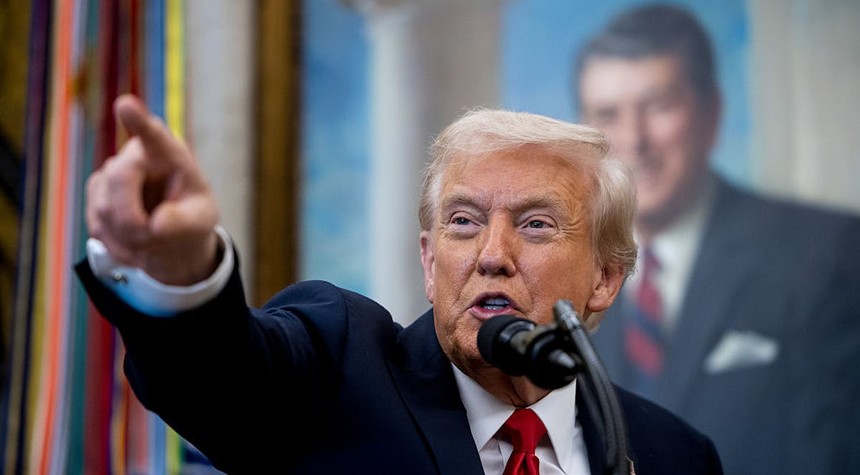
President Donald Trump has renewed his push for eliminating the Senate filibuster, arguing that maintaining the 60-vote threshold will doom Republican electoral prospects and legislative achievements. The facts here are straightforward: Trump believes that without this procedural change, the conservative agenda will remain perpetually stalled.
Writing on Truth Social, Trump laid out his reasoning with characteristic directness. He contends that Democrats will weaponize the filibuster to obstruct Republican priorities for years, ultimately shifting electoral blame onto the GOP for legislative inaction. This is not an unreasonable concern. When voters perceive governmental gridlock, they typically punish the party in power, regardless of which party actually blocks legislation.
Trump’s proposed legislative agenda includes election integrity reforms, prohibiting biological males from competing in women’s sports, border security measures, tax cuts, energy deregulation, and Second Amendment protections. These represent core conservative priorities that consistently poll well among Republican voters and many independents. The question becomes whether procedural preservation outweighs policy achievement.
The President’s argument contains a critical warning: Democrats themselves attempted filibuster elimination during their recent Senate control, with only Senators Joe Manchin and Kyrsten Sinema preventing its demise. Both senators have since left the Democratic caucus or retired. This suggests that Democratic commitment to the filibuster as an institution is purely tactical, not principled. If Republicans maintain the rule while Democrats plan to eliminate it at their next opportunity, conservatives face a strategic disadvantage.
Here is where the analysis becomes more complex. The filibuster has historically protected conservative interests when Republicans hold the minority. It prevented numerous progressive priorities during the Biden administration, including federalizing election law, codifying abortion rights nationwide, and implementing gun control measures. These were significant victories for conservatives achieved through procedural means rather than electoral majorities.
The counterargument is equally valid: if Democrats will eliminate the filibuster regardless, Republicans gain nothing by preserving it now. They merely postpone inevitable progressive legislation while sacrificing their current opportunity to enact conservative reforms. This represents a classic game theory problem where cooperation only functions if both parties maintain good faith.
Trump’s timing coincides with a 31-day government shutdown that has stalled critical programs. His frustration with legislative paralysis is understandable, particularly when Republicans control both chambers and the presidency. The conservative base elected Republicans to govern, not merely to prevent Democratic governance.
However, institutional conservatives including Senate leadership have consistently resisted this approach. Their concern centers on long-term consequences. The filibuster represents one of the few remaining mechanisms that encourages bipartisan cooperation and protects minority rights in the Senate. Once eliminated, it cannot be easily restored.
The fundamental question is whether Republicans should prioritize immediate policy victories or long-term institutional stability. Trump argues that policy success will generate electoral dominance that makes the filibuster irrelevant. Critics contend that political fortunes change, and future Republican minorities will regret eliminating this protection.
Democrats have demonstrated their willingness to erode Senate norms when convenient, having eliminated the filibuster for judicial nominees below the Supreme Court level in 2013. Republicans responded by extending that elimination to Supreme Court nominees in 2017. This escalation pattern suggests Trump may be correct about Democratic intentions.
The strategic calculation requires assessing whether maintaining institutional norms with an opponent who rejects those norms constitutes wisdom or foolishness. That remains the central debate within Republican ranks.
Related: Trump Administration Defeats Proposed UN Global Shipping Tax in Final Hour