
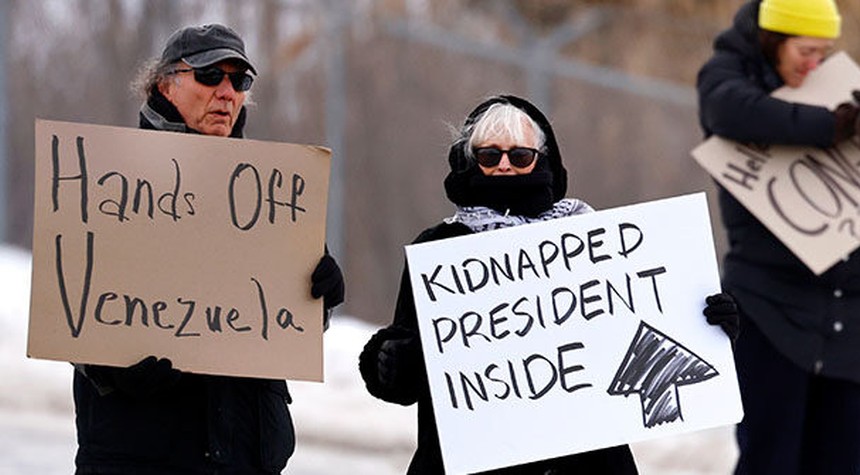
The Democratic National Committee has decided that apprehending a socialist dictator wanted on narco-terrorism charges represents an excellent fundraising opportunity. Let’s examine the facts here, because they matter.
The Trump administration successfully captured Nicolás Maduro, Venezuela’s illegitimate ruler who maintained power through fraudulent elections, along with his wife Cilia Flores. Maduro faces charges including narco-terrorism conspiracy, cocaine importation conspiracy, and conspiracy to possess machine guns and destructive devices against the United States. The U.S. government maintained an active $50 million bounty for information leading to his arrest and conviction.
These are not minor infractions. This is a dictator who transformed one of South America’s wealthiest nations into a humanitarian catastrophe while allegedly running a narco-terrorist operation. The charges are serious, the evidence substantial, and the bounty significant.
Yet the DNC’s response? Fundraising emails and constitutional lectures.
“Another day, another unconstitutional war from Trump, who thinks the Constitution is a suggestion,” the DNC email declared. “Congress has war powers — but Republican cowards are hiding under their desks while Trump orders an unauthorized attack against Venezuela.”
Several problems emerge immediately. First, arresting a wanted criminal with an active U.S. bounty does not constitute “war” in any constitutional sense. Second, if Democrats genuinely believed this action violated constitutional war powers, the appropriate response involves legal challenges and congressional action, not fundraising appeals. Third, the email conveniently ignores that Maduro was already wanted by U.S. authorities on multiple federal charges.
DNC Chairman Ken Martin escalated the rhetoric further, claiming Trump “committed the United States to an uncertain role in South America with an indeterminate timeline.” He characterized the arrest as “the worst kind of betrayal” and accused Trump of abandoning the Constitution “as a last-ditch effort to hold on to power and relevancy.”
This argument collapses under minimal scrutiny. Executing an arrest warrant for a wanted criminal represents standard law enforcement, not constitutional abandonment. The timeline is quite determinate: Maduro faces trial on specific charges in U.S. courts, where he will receive due process.
The larger question becomes unavoidable: When did the Democratic Party decide that opposing the arrest of narco-terrorist dictators represents sound political strategy?
Venezuela under Maduro descended into complete societal collapse. Hyperinflation destroyed the economy. Millions fled as refugees. Basic necessities became unavailable. Meanwhile, evidence mounted regarding the regime’s involvement in international drug trafficking operations.
The Trump administration’s action removed a destabilizing criminal actor from power. This benefits regional security, supports the Venezuelan people suffering under socialist tyranny, and enforces U.S. law against narco-terrorism.
Democrats could have responded by supporting law enforcement while ensuring proper constitutional processes moving forward. Instead, they chose to fundraise off opposition to capturing a wanted criminal.
The DNC email concluded by urging supporters to “elect more Democrats who will check this administration’s power.” Translation: send money so we can oppose arresting drug-trafficking dictators.
This represents a fundamental misunderstanding of both constitutional war powers and basic law enforcement. Worse, it suggests the Democratic Party views every Trump administration action, regardless of merit, purely as fundraising fodder.
Facts matter. Maduro was wanted on serious federal charges. A substantial bounty existed. His capture serves American interests and regional stability. These facts remain true regardless of political convenience.
The Democratic Party owes Americans an explanation for why they believe this arrest warrants opposition rather than support.
Related: Mark Kelly Faces Formal Military Consequences for Urging Troops to Defy Orders