When China Controls the Essentials
Here’s something that should keep you up at night: China controls roughly 70% of rare earth mining worldwide and a staggering 90% of rare earth processing. Let that sink in for a moment. We’re talking about the materials that go into everything from your smartphone to the guidance systems on our missiles. And we’ve essentially handed Beijing the keys to the entire operation.
This isn’t some abstract geopolitical chess game. This is about whether America can build the weapons we need to defend ourselves. It’s about whether our economy can function without asking permission from a regime that views us as their primary adversary.
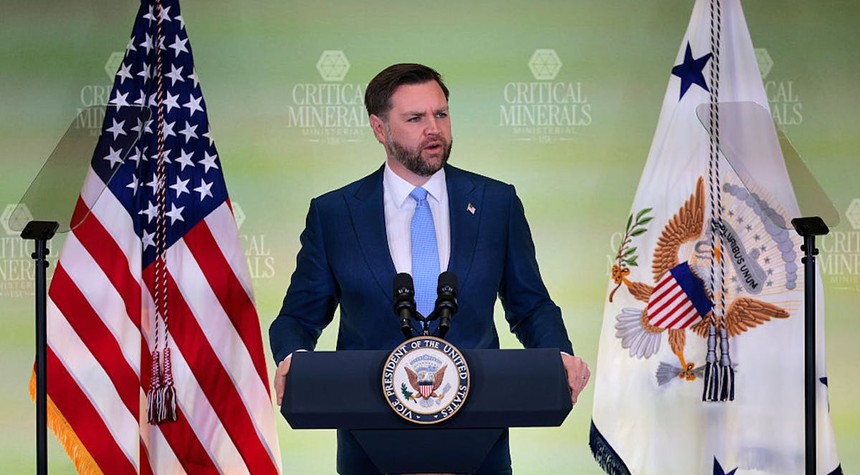
Vice President JD Vance stood before representatives from over 50 countries Wednesday and said what needed saying. The Trump administration is done playing defense on critical minerals. They’re building a trading bloc, a preferential trade zone that’ll stabilize markets and break China’s chokehold on resources that power modern civilization.
The vice president spoke at the inaugural Critical Minerals Ministerial, hosted by the State Department. His message was clear: we’re creating reliable production centers and supply chains that Beijing can’t touch, can’t manipulate, can’t weaponize against us.
Project Vault and the Stockpile Strategy
Just two days before Vance’s announcement, President Trump rolled out Project Vault. The initiative aims to stockpile critical minerals, protecting American companies and consumers from supply chain disruptions. You know, the kind of disruptions that happen when you let a hostile power control the resources your entire economy depends on.
This isn’t complicated. When one country dominates a market this thoroughly, they can flood it with cheap materials whenever they want to crush competitors. They can restrict supply when it serves their interests. They can use access as leverage in negotiations. We’ve watched this playbook before with other commodities.
The Trump administration gets it. They’re not interested in half measures or symbolic gestures. They want enforceable price floors to prevent dumping. They want diversified supply chains that can’t be severed by a single actor’s whim. They want American manufacturers protected from predatory pricing designed to eliminate competition.
Building Alliances That Actually Matter
There’s something refreshing about this approach. Instead of lectures about international norms or vague commitments to cooperation, we’re talking about concrete mechanisms. A preferential trade zone means something. It means countries that play by the rules get access. It means we strengthen partners who share the burden of maintaining stable markets.
Vance emphasized the importance of diversifying supply while strengthening partner countries. That’s smart policy. We’re not trying to do this alone, and we’re not pretending every nation deserves equal treatment regardless of their behavior. We’re building a coalition of the willing, countries that recognize China’s dominance threatens everyone’s security.
Think about the strategic implications here. If you’re a country with critical mineral deposits, you’ve probably felt pressure from Beijing. Maybe they’ve offered infrastructure deals with strings attached. Maybe they’ve threatened market access if you don’t cooperate. Now there’s an alternative. A trading bloc backed by American economic and military power, offering genuine partnership instead of debt traps.
The Free Market Needs Guardrails
Some folks might bristle at the idea of price floors and preferential trade zones. Aren’t conservatives supposed to believe in unfettered free markets? Well, here’s the thing: there’s nothing free about a market where one authoritarian regime manipulates supply and pricing to achieve geopolitical goals.
True competition requires a level playing field. When China subsidizes production to undercut competitors, when they use state power to control resources, when they weaponize market access, that’s not capitalism. That’s economic warfare dressed up in trade statistics.
The Trump administration is proposing guardrails that let actual competition flourish. They’re creating space for multiple producers to operate without getting crushed by predatory pricing. They’re ensuring that countries investing in mining and processing can count on stable returns instead of watching Chinese state enterprises destroy their markets overnight.
This matters for national defense in ways most people don’t appreciate. Modern military equipment depends on these materials. Fighter jets, satellites, precision weapons, communications systems. All of it requires rare earths and critical minerals. Relying on China for these inputs is strategic insanity.
What Happens Next
Over 50 countries sent representatives to this ministerial. That’s not nothing. It signals genuine interest in finding alternatives to Chinese dominance. But interest and action are different things. The real test comes in implementation.
Will these countries commit to developing their own mining and processing capacity? Will they resist Chinese pressure and economic incentives to stay in Beijing’s orbit? Will they enforce the rules of this preferential trade zone when it gets difficult?
The Trump administration is offering a framework. They’re providing American backing, both economic and strategic. They’re creating incentives for cooperation. But this only works if our partners show up ready to do the hard work.
And make no mistake, it’ll be hard. China didn’t build this dominance overnight, and we won’t break it quickly. Mining projects take years to develop. Processing facilities require massive investment. Supply chains need time to establish and stabilize.
But the alternative is accepting permanent dependence on a regime that views us as their enemy. The alternative is watching China leverage control over critical minerals the same way OPEC once wielded oil. The alternative is losing the ability to defend ourselves because we can’t source the materials our weapons require.
That’s not acceptable. It never was. The Trump administration deserves credit for finally treating this threat with the seriousness it demands. Now comes the hard part: following through.
Related: New Report Exposes Tlaib’s Financial Ties to Terror-Linked Networks