
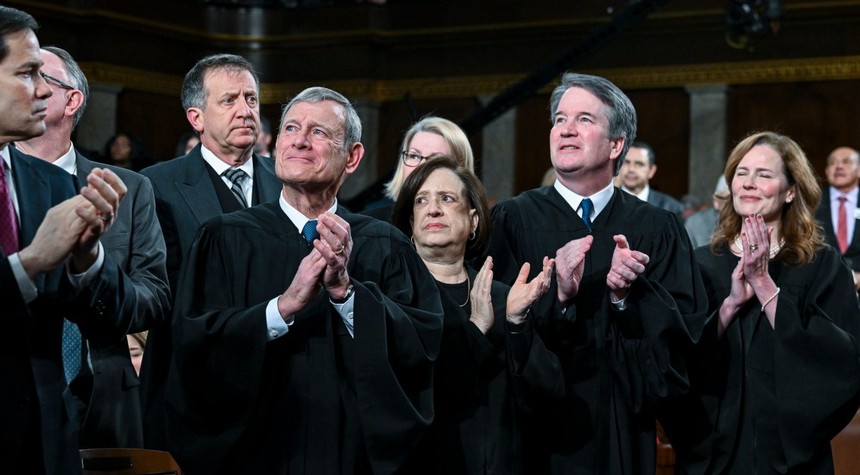
President Donald Trump demonstrated uncharacteristic restraint during his State of the Union address Tuesday night when confronted with the physical presence of three Supreme Court justices who had just delivered him a devastating legal defeat on tariffs.
The facts are straightforward. Chief Justice John Roberts, Justice Amy Coney Barrett, and Justice Elena Kagan attended the address despite having joined a 6-3 majority decision released Friday that struck down most of Trump’s tariff regime as unlawful. Justice Brett Kavanaugh, who dissented in favor of the administration’s position, also attended.
During his speech, Trump characterized the ruling as “disappointing” and “unfortunate” while the justices maintained their traditional stoic demeanor. He greeted each justice individually upon entering the chamber. That was it. No fireworks, no dramatic confrontation, no extended commentary on what represents a significant setback to his economic agenda.
This measured approach stands in stark contrast to Trump’s immediate reaction Friday, when he unleashed a withering critique of the majority justices, calling them a “disgrace to our nation” and “very unpatriotic and disloyal to the Constitution.” He even suggested foreign influence had corrupted their decision-making process.
Here is where the situation becomes particularly noteworthy: two of the justices who ruled against Trump, Barrett and Neil Gorsuch, were his own appointees. These are justices he personally selected, presumably because he believed they would adhere to constitutional principles. Apparently, they did exactly that, and Trump did not appreciate the outcome.
The contrast between Trump’s Friday tirade and his Tuesday temperance raises important questions about presidential decorum and institutional respect. Trump clearly understood that attacking Supreme Court justices to their faces during a nationally televised address would cross a line that even his most ardent supporters might find uncomfortable.
Supreme Court justices attend the State of the Union in their official capacity, not as political partisans. They sit through what has devolved into an increasingly partisan spectacle, refraining from applause or any display of support for presidential policies. It is an uncomfortable tradition that even Roberts has criticized, noting that “to the extent the State of the Union has degenerated into a political pep rally,” the optics create problems for judicial independence.
Conservative Justices Samuel Alito and Clarence Thomas, who dissented alongside Kavanaugh in support of Trump’s tariff authority, typically skip the event entirely. They understand that the modern State of the Union has become less about informing Congress and more about political theater.
The underlying legal question remains significant. The Supreme Court determined that Trump exceeded his constitutional authority in implementing these tariffs. Whether one agrees with that conclusion or not, the ruling represents the judiciary performing its constitutional function as a check on executive power.
Trump praised the dissenting justices Friday, including Kavanaugh, his third Supreme Court appointee. This selective appreciation for judicial decisions based on outcomes rather than reasoning is precisely the kind of results-oriented thinking that undermines respect for the rule of law.
The president showed wisdom in tempering his remarks Tuesday night. The question is whether this represents genuine recalibration or merely tactical restraint when cameras are rolling and justices are watching.
Related: VA Disability Rule Change Threatens Benefits for Millions of Veterans Despite Pause