
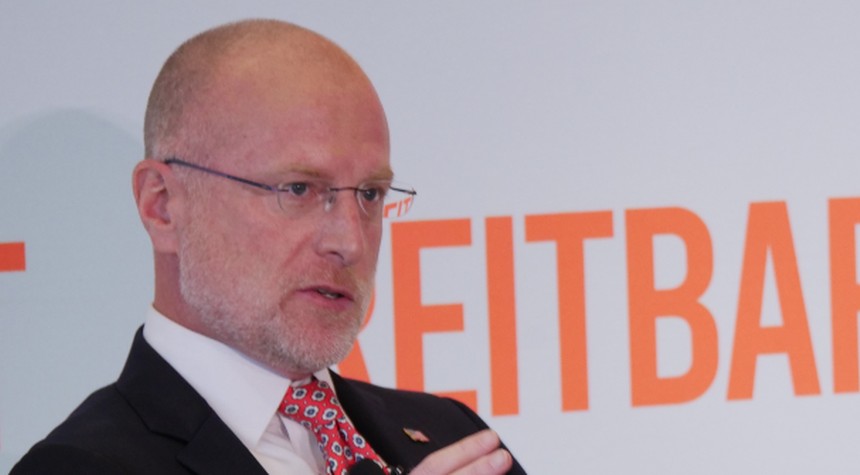
Here’s a stat that should make every network executive in Manhattan break out in a cold sweat. Fifteen percent of Americans would eat gas station sushi. Only nine percent trust the legacy national media. FCC Chairman Brendan Carr dropped that gem at a Breitbart News policy event this week, and honestly, it tells you everything you need to know about where we are as a country.
Carr isn’t just throwing around statistics for shock value. He’s actually doing something about the problem. The FCC is working to reinvigorate local broadcast television stations, shifting power away from the coastal programming elites who’ve had a stranglehold on what Americans watch for far too long. It’s about time someone in Washington recognized that your local news anchor probably understands your community better than some producer in a Hollywood office tower.
The current rules are strangling local broadcasters. One entity can’t own stations reaching more than 39 percent of American households. There’s also the “top 4” rule that limits ownership of ABC, CBS, Fox, and NBC affiliates. Similar restrictions hamstring AM and FM radio ownership. These regulations made sense once, maybe. But over the years, they’ve created an imbalance where national programmers call all the shots and local stations have become little more than content distribution points for New York and Hollywood.
Think about what you’re actually watching when you tune into your local station. How much of it is genuinely local anymore? In too many cases, your hometown broadcaster is just piping in programming created by people who’ve never set foot in your state, let alone your county. That’s not what local television was supposed to be. These stations operate on public airwaves, which means they have an obligation to serve their communities with real, thoughtful news coverage. Not just repackaged national narratives with a local weather segment tacked on.
Carr credits President Trump with fundamentally reshaping the entire media ecosystem, and he’s not wrong. For decades, politicians accepted whatever narrative the legacy media handed down. They were scared to fight back, scared to challenge the gatekeepers who controlled the megaphone. Trump changed that calculation entirely. He set the terms of debate instead of letting CNN and The New York Times do it for him. He smashed the facade that a handful of coastal elites get to control what we think and say.
The emperor has no clothes, and everyone can see it now. That’s why trust in national media is lower than willingness to risk questionable seafood from a Chevron station. People aren’t stupid. They recognize propaganda when it’s dressed up as journalism.
The FCC’s openness to changing ownership caps isn’t just about media diversity for its own sake. It’s strategic. Loosening these restrictions could constrain the power of national programmers like NBC while simultaneously introducing new competition for advertising dollars. And you know who that hurts? Big tech. Google and Facebook have feasted on advertising revenue that used to sustain local journalism. Creating more robust local broadcasters means spreading those ad dollars around, which means less concentrated power in Silicon Valley boardrooms.
This matters beyond just media politics. Strong local news operations are essential for functioning communities. They cover city council meetings, high school sports, local crime, community events. The stuff that actually affects your daily life more than whatever manufactured outrage is trending on Twitter. When local stations become hollow shells just rebroadcasting national content, communities lose that connective tissue.
Free market principles should apply here too. Let broadcasters compete, consolidate where it makes sense, and serve their audiences without arbitrary federal limits that only benefit entrenched national players. The current system props up a media establishment that’s failed Americans spectacularly. Time to try something different.
Carr’s approach recognizes a fundamental truth that conservatives have understood for years. Decentralization works. Local control works. People closest to problems are usually best equipped to solve them. That applies to governance, and it applies to news coverage too. A reporter who lives in your town, sends their kids to your schools, and shops at your grocery stores will cover local issues differently than someone parachuting in from a national network.
The legacy media’s collapse in public trust didn’t happen by accident. It’s the natural consequence of decades spent lecturing Americans instead of informing them, pushing narratives instead of reporting facts, and serving partisan interests instead of public ones. Local broadcasters have a chance to fill that void, but only if they’re empowered to actually be local again.
Related: House Committee Wants NSF to Pull $67 Million From Universities Playing Footsie With Beijing