
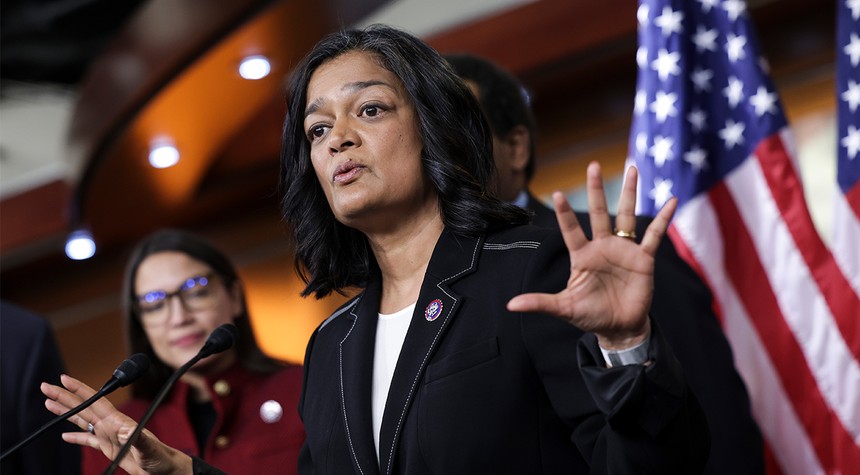
Rep. Pramila Jayapal wants you to believe she’s defending the Constitution. The Washington Democrat stood before cameras after Thursday’s House vote on the Iran War Powers Resolution, invoking Article I with the kind of reverence usually reserved for sacred texts. Congress alone has the power to declare war, she reminded us. We can’t put troops at risk based on any president’s opinion, acting unilaterally.
It sounds noble until you think about it for more than thirty seconds.
The resolution would’ve required President Trump to terminate any use of armed forces against Iran unless Congress explicitly authorized it. Think about what that means in practice. You’re the Commander in Chief. Intelligence comes across your desk showing an imminent threat to American lives or interests. But before you can act, you need to convene 535 members of Congress, many of whom will leak to their favorite reporters before the meeting even ends, debate the matter for days or weeks, and hope that partisanship doesn’t override national security. That’s not constitutional governance. That’s paralysis dressed up as principle.
Here’s what really bothers me about Jayapal’s argument. She’s wrapping a fundamentally political objection in constitutional language. This isn’t about preserving congressional authority. It’s about Trump. The woman has been a longtime critic of this president, which is her right, but let’s not pretend this resolution would’ve gotten anywhere near the House floor under a different administration. Where was this passionate defense of Article I during the Obama years when drone strikes became routine and Libya turned into a disaster without proper congressional authorization?
The Founders understood something Jayapal seems to miss. They gave Congress the power to declare war, yes, but they made the president Commander in Chief for a reason. War in the 18th century meant months of preparation, moving troops across oceans, mobilizing entire economies. Modern conflict doesn’t work that way anymore. Threats emerge in hours. Decisions must be made in minutes. The constitutional framework allows for this. It’s why we have the War Powers Act, imperfect as it is.
Jayapal warns about long-term consequences and insists this shouldn’t be partisan. But everything about this resolution screams partisan politics. House lawmakers split largely along party lines. Republicans saw it for what it was, an attempt to kneecap a president during a critical moment in foreign policy. Democrats, still nursing their wounds from 2016, couldn’t resist another chance to tie Trump’s hands.
You know what’s actually dangerous? Broadcasting to our enemies that America’s political class is so divided we can’t present a unified front even when our interests are directly threatened. Iran watches this theater. So does China, Russia, and every other adversary looking for weakness to exploit. When Congress publicly debates whether the president should even have authority to respond to aggression, we’re sending a signal that emboldens bad actors.
The irony is thick. Jayapal claims she wants to protect our troops from being put at risk based on presidential opinion. But limiting the president’s ability to respond swiftly and decisively puts those same troops in greater danger. Our enemies become bolder when they sense hesitation. They probe for weakness when they see division.
This isn’t about defending some abstract constitutional principle. It’s about whether America can function as a coherent nation in a world that doesn’t care about our domestic squabbles. Limited government matters. Constitutional restraints matter. But so does recognizing that the executive must have authority to protect American interests when Congress is too slow, too divided, or too political to act.
Jayapal got her vote. The resolution passed the House but went nowhere in the Senate, which tells you everything you need to know about its substance. It was political theater, nothing more. But the damage from that theater lingers. Every time Congress publicly questions whether a president can defend the nation, we weaken ourselves just a little bit more.
Related: Schumer Declares War on Voter ID as Trump Demands Action on SAVE Act