
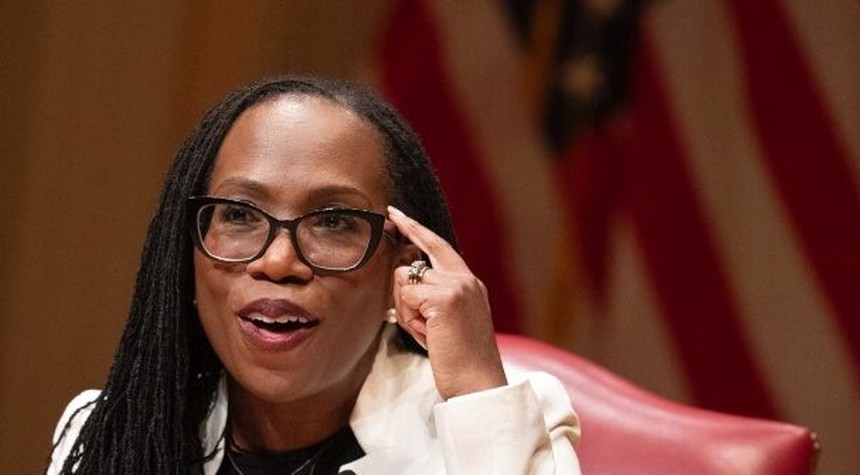
Justice Ketanji Brown Jackson just gave us a masterclass in how to stretch constitutional interpretation beyond recognition. During oral arguments Wednesday in Trump v. Barbara, she floated the idea that foreign tourists vacationing in America possess something called “local allegiance” to the United States. And apparently, this fleeting connection is enough to grant their newborn children automatic American citizenship.
Let’s be clear about what we’re discussing here. This case challenges President Trump’s executive order ending birthright citizenship for children born to illegal aliens and foreign tourists. These are the anchor babies we’ve been debating for years. Around 250,000 of them arrive annually, instant Americans by virtue of geographic happenstance.
Jackson’s reasoning? Well, she conjured up a hypothetical about stealing wallets in Japan. If she visited Tokyo and someone nabbed her purse, Japanese authorities could prosecute the thief. And if she were the thief, they could arrest her too. Therefore, she argued, even temporary travelers owe “local allegiance” to whatever country they’re passing through. It’s the kind of logic that sounds almost reasonable until you think about it for more than thirty seconds.
The problem isn’t that Jackson’s wrong about local jurisdiction. Of course foreign visitors must follow local laws. That’s not allegiance in any meaningful constitutional sense. That’s just how sovereignty works. When I drive through Virginia, I have to follow Virginia traffic laws. That doesn’t make me a Virginian, and it certainly shouldn’t make my hypothetical child born during a rest stop a permanent ward of the Commonwealth.
What Jackson is doing here, whether intentionally or not, is conflating temporary legal jurisdiction with the permanent political allegiance the 14th Amendment contemplates. The amendment was crafted to ensure freed slaves received citizenship. It was never designed to turn every maternity ward into a citizenship factory for foreign nationals who happen to time their vacations poorly.
You know what’s fascinating about this whole debate? The Supreme Court has never explicitly ruled on whether birthright citizenship extends to children of illegal aliens or tourists. Never. We’ve been operating on assumptions and lower court interpretations for decades. Leading constitutional scholars have been screaming into the void that this wasn’t the framers’ intent, but nobody wanted to touch the political third rail.
The 14th Amendment’s language about being “subject to the jurisdiction thereof” wasn’t throwaway verbiage. It meant something specific about political allegiance and obligation. Foreign tourists maintain allegiance to their home countries. They’re here temporarily, subject only to our criminal and civil laws in the most basic sense. They can’t vote, can’t serve on juries, can’t be drafted. Their loyalty lies elsewhere, as it should.
Jackson’s wallet analogy reveals something deeper about progressive constitutional interpretation. It’s the tendency to expand definitions until they encompass whatever outcome feels right emotionally. Local jurisdiction becomes local allegiance. Temporary presence becomes sufficient connection. A vacation becomes a social contract.
The conservative position isn’t about cruelty or exclusion. It’s about precision and permanence. Citizenship means something. It’s not a party favor you hand out to anyone who shows up. It’s a mutual compact between individual and nation, requiring genuine allegiance and commitment. When we cheapen that by granting it automatically to tourists’ children, we diminish what it means to be American.
This case matters because it forces us to confront questions we’ve dodged for generations. What does birthright citizenship actually mean? Who gets to be American and why? These aren’t abstract constitutional puzzles. They’re fundamental questions about national identity and sovereignty that deserve honest answers, not stretched analogies about stolen wallets in Tokyo.
The oral arguments suggest a Court wrestling with text, history, and consequence. That’s exactly what should happen. Whatever the justices decide, at least we’re finally having the conversation that should have occurred decades ago.
Related: Trump Considers Ditching NATO and Honestly It’s About Time Someone Did