
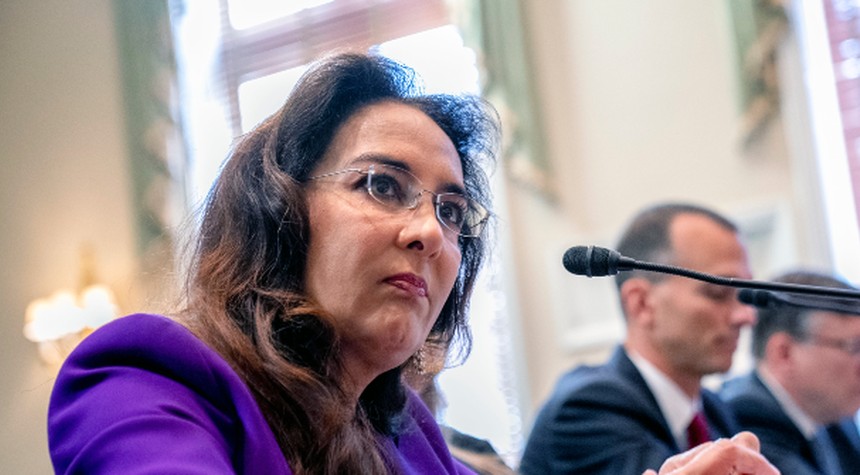
The Second Amendment just got itself a formidable champion in the Justice Department, and Harmeet Dhillon isn’t mincing words about where this is headed. The Assistant Attorney General for Civil Rights told Just the News this week that the Supreme Court will rule AR-15s are “legal all over America,” and if you’re a blue state politician who’s spent years grandstanding about assault weapons bans, you might want to start workshopping your next campaign issue.
Dhillon’s prediction came alongside news that the DOJ has filed lawsuits against Denver’s ban on semiautomatic rifles and Colorado’s magazine capacity restrictions. This isn’t just legal posturing. This is the federal government telling states and cities that their patchwork gun control schemes are about to meet an immovable constitutional wall.
Here’s what makes Dhillon’s confidence so compelling. She’s not pulling this prediction from thin air or wishful thinking. The Supreme Court already ruled 9-0 in the Smith and Wesson case that the AR-15 is the most commonly owned and operated rifle in America. Nine to zero. That’s not a conservative court versus a liberal court situation. That’s unanimous recognition of statistical reality.
When you layer that unanimous decision over the Bruen and Heller rulings, which firmly established that firearms in common use by law-abiding citizens receive Second Amendment protection, you arrive at what Dhillon calls an “inexorable conclusion.” The AR-15 isn’t some exotic weapon system. It’s the most popular rifle in the country, owned by millions of Americans who’ve never committed a crime and never will.
Dhillon framed the issue perfectly when she said, “The Constitution is not a suggestion, and the Second Amendment is not a second-class right.” That statement cuts through years of progressive rhetoric that’s treated gun ownership as some kind of embarrassing holdover from a less enlightened era. The founders didn’t rank the amendments by importance, and they certainly didn’t intend for judges and politicians to treat some rights as more negotiable than others.
The DOJ’s aggressive legal strategy represents a seismic shift from previous administrations that either ignored Second Amendment infringements or actively encouraged them. Filing back-to-back lawsuits against Denver’s rifle ban and Colorado’s magazine restrictions signals that this Justice Department isn’t interested in incremental progress or polite negotiations. They’re going for the jugular.
Colorado Democrats banned magazines holding more than 15 rounds, because apparently the Constitution has a footnote about acceptable ammunition capacity that nobody noticed for 230 years. These arbitrary restrictions have always been about politics, not public safety. Criminals don’t comply with magazine limits, and mass shooters don’t abandon their plans because they have to carry an extra magazine.
What’s fascinating about this moment is how it exposes the fundamental dishonesty of the gun control debate. Progressives have spent decades insisting they respect the Second Amendment while systematically dismantling it through regulation, restriction, and outright bans. They’ve treated “common sense gun control” as a synonym for “whatever we can get away with.”
Now the legal ground is shifting beneath their feet. Bruen already forced New York and other may-issue states to abandon their subjective permitting schemes. If the Supreme Court follows the logic Dhillon outlined, every assault weapons ban in the country becomes constitutionally indefensible. California, New York, Massachusetts, Connecticut, and a handful of other blue states would have to repeal laws they’ve championed for years.
You can already hear the outrage machine warming up. Gun control advocates will claim this puts Americans in danger, that we’re prioritizing gun rights over children’s lives, that the Supreme Court is out of touch with modern values. They’ll trot out the same emotional appeals that have always substituted for constitutional arguments.
But here’s the thing about constitutional rights. They’re not subject to polling. They don’t change based on how scared or outraged people feel. The Second Amendment means what it means, and if AR-15s are in common use by law-abiding Americans, then states don’t get to ban them just because progressive legislators find them scary or politically useful to demonize.
Dhillon called the AR-15 ban “low-hanging fruit,” and she’s right. This is the clearest case imaginable for Second Amendment protection. If the Supreme Court can’t defend the most popular rifle in America from state-level prohibition, then the right to bear arms doesn’t mean anything at all.
The legal battles ahead will be fierce. Blue states won’t surrender their gun control regimes without exhausting every procedural option and filing every possible brief. But the constitutional logic is sound, the precedents are clear, and the Justice Department is finally willing to fight. That’s a combination that should terrify anyone who’s built a political career on chipping away at the Second Amendment.
Related: Porter’s Immigration Gaffe Reveals the Left’s Population Replacement Strategy