
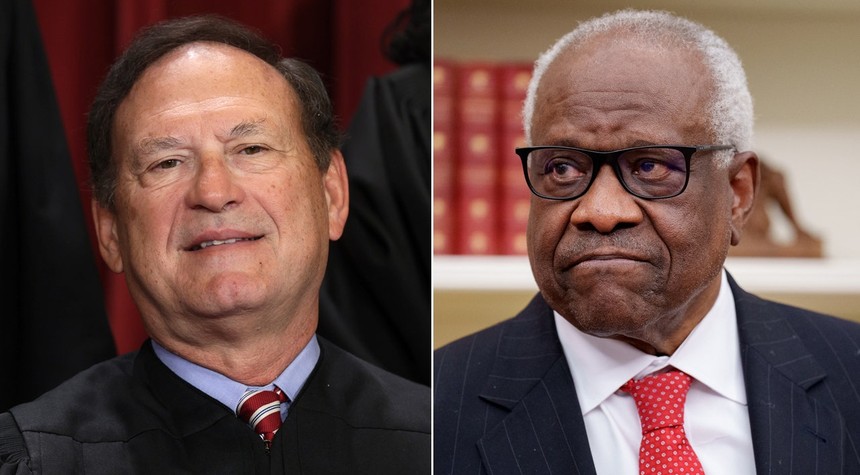
There’s something deeply wrong when two Supreme Court justices have to remind us that treating people differently based on race is exactly what the Constitution forbids. Yet here we are. Justices Samuel Alito and Clarence Thomas just issued a dissent that should make every American pause and think hard about where we’re headed.
The case involves Donte J. Carter, a Black man whose firearm and theft convictions got tossed after the D.C. Court of Appeals decided police seized him without reasonable suspicion. Officers found a stolen .40-caliber pistol in his pants, a weapon taken from an FBI agent’s vehicle. But the D.C. court ruled the seizure unlawful based on reasoning that should alarm anyone who values equal treatment under the law.
The court’s logic? Black Americans are especially distrustful of law enforcement and therefore less likely to terminate a police encounter than other people. They’re skeptical that cops will respect their constitutional rights, so a reasonable Black person wouldn’t feel free to end the encounter. This means what looked like a consensual interaction was actually a seizure requiring reasonable suspicion first.
Sounds sympathetic on the surface, right? Who can deny that trust issues exist between law enforcement and minority communities? But Alito and Thomas see the trap here. They’re not disputing history or pretending problems don’t exist. They’re pointing out that creating race-based standards for police encounters turns the Constitution on its head.
“It is dangerous to allow an individual to be treated differently based on statistics, studies, or expert testimony that purports to show that members of the racial or ethnic group to which he belongs are more likely to act in a certain way than are members of other groups,” Alito wrote. Read that again slowly. This isn’t about ignoring real problems. It’s about refusing to solve them by institutionalizing racial categorization.
The practical implications are staggering. Officers now face an impossible task. They must quickly assess someone’s race during a tense encounter and then apply different constitutional standards based on that assessment. What about dark-skinned Latinos versus other Latinos? What about members of other minority groups? Where do mixed-race individuals fall? You see the problem. We’re asking cops to become amateur sociologists making split-second racial calculations that determine which rulebook applies.
This case helped Carter by getting his conviction vacated. But Alito and Thomas aren’t shortsighted. “Here, the special treatment helped the individual; in other situations it will not,” they warned. Once you establish that race determines how constitutional protections apply, you’ve opened a door that swings both ways. Today’s sympathetic application becomes tomorrow’s justification for treating minorities with extra suspicion.
The irony is bitter. We spent generations fighting to establish that the Constitution is colorblind, that government actors almost never get to treat people differently based on race. Now a court says officers must do exactly that, wrapping the requirement in progressive language about acknowledging historical mistrust. But good intentions don’t justify bad precedent.
Thomas knows something about this. He’s spent his career arguing against racial preferences and classifications, even when they’re marketed as remedies for past wrongs. He understands that you can’t achieve equal treatment by mandating unequal treatment. You can’t build colorblindness by forcing everyone to obsess over color.
The Supreme Court refused to take up this case, which means the D.C. ruling stands. That’s troubling. Lower courts now have permission to craft race-specific constitutional standards based on social science testimony about group behavior. We’re replacing individual rights with group identities, substituting stereotypes (even sympathetic ones) for the principle that each person deserves equal treatment.
Law enforcement already operates in an impossible environment. Officers make instant decisions that lawyers and judges dissect for months afterward. Now add racial guessing games to that burden. Get it wrong and face accusations of discrimination. Get it right but apply the wrong standard and watch criminals walk free.
This isn’t justice. It’s chaos wrapped in compassion. And two justices just tried to warn us before it’s too late.
Related: Colorado Socialist Wants a Trans Bill of Rights While Calling Child Protection Laws Horrific