
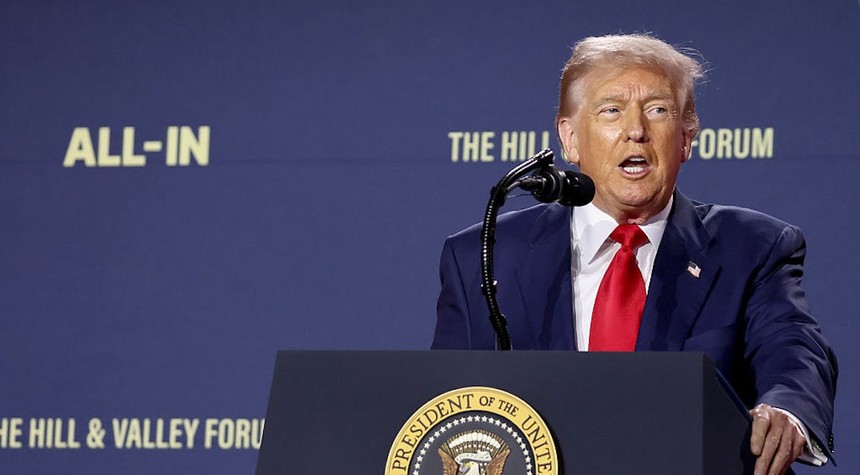
There’s a moment in every one-sided relationship when someone finally says enough. That moment arrived Friday when President Trump looked at the European Union’s latest cash grab against American innovation and decided the piggybank was officially closed.
The EU just hit Google with another billion dollar fine. Not for anything new or particularly egregious, mind you. Just another day, another shakedown of American enterprise by European bureaucrats who’ve apparently decided that fining successful companies is easier than building their own. This brings Google’s total tab with Brussels to a staggering $18 billion. Let that number sit for a second.
The president didn’t mince words on Truth Social. He called out what everyone’s been watching happen in slow motion since the Biden years. Apple dinged for $15 billion. Meta for $3 billion. Amazon for $2.5 billion. The pattern isn’t subtle. Europe sees American success and reaches for its regulatory hammer, dressed up in fancy antitrust language that somehow never seems to target European companies with quite the same enthusiasm.
You know what’s remarkable about these fines? The explanations are always vague, always couched in the kind of bureaucratic double-speak that makes your eyes glaze over. Competition concerns, they say. Market dominance, they claim. But strip away the jargon and you’re left with a simple truth that Trump articulated perfectly. This is discriminatory, and it started ramping up precisely when America had leadership too timid to push back.
The free market is supposed to reward innovation and efficiency. These companies didn’t stumble into dominance. They built products people actually wanted to use. They created value from nothing, employed millions, and changed how the world communicates and does business. That’s not a crime. That’s capitalism working exactly as intended.
But here’s where it gets interesting. The EU doesn’t have a Google. It doesn’t have a Meta or an Amazon or an Apple. Its tech sector, for all the talent and resources available across the continent, hasn’t produced anything close to matching American innovation. So instead of fostering an environment where European companies could compete, regulators have chosen the path of least resistance. Fine the Americans. Call it consumer protection. Collect billions.
Trump’s threat of substantial tariffs isn’t bluster. It’s the natural response to what amounts to economic hostility dressed in regulatory clothing. You can’t have a trade relationship where one side treats the other’s most successful companies as ATMs while expecting business as usual on everything else. That’s not partnership. That’s exploitation.
The timing matters too. During the previous administration, these fines escalated without serious pushback. European regulators learned they could levy eye-watering penalties and face nothing more than strongly worded objections. That calculation just changed. Trump’s making clear that actions have consequences, and if Europe wants to play hardball with American enterprise, it shouldn’t be surprised when America responds in kind.
This isn’t about defending corporate giants because they’re American. It’s about recognizing a pattern of behavior that undermines fair competition and punishes success. The companies being targeted didn’t break laws. They succeeded in the marketplace. There’s a difference, and it matters.
The president called Google “a truly advanced and amazing group,” and he’s right. These are companies that represent the best of American ingenuity. Watching foreign governments treat them like criminal enterprises for the sin of being good at what they do should bother anyone who believes in merit and competition.
Europe needs to decide what kind of relationship it wants with America. The free ride just ended.
Related: New Bill Slashes Sentencing Thresholds for Fentanyl Traffickers as Death Toll Climbs