
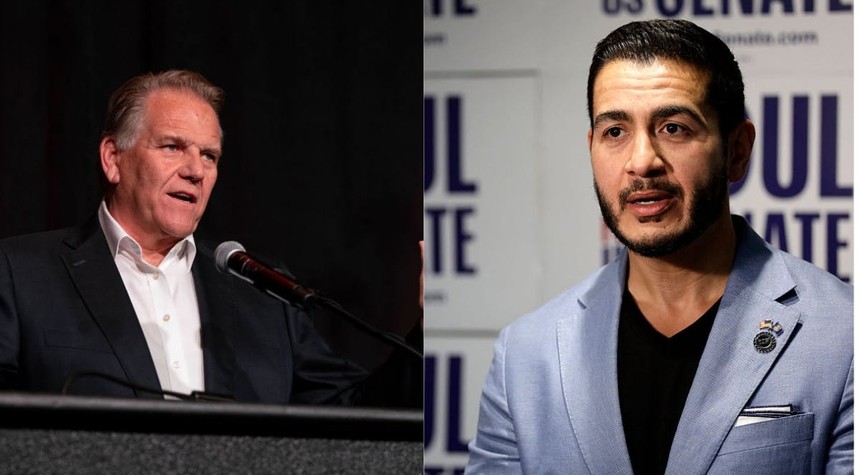
When someone tells you that your feelings might have been hurt by their words, they’re not actually apologizing. They’re performing damage control. Mike Rogers understands this distinction, and he’s not letting Abdul El-Sayed get away with what amounts to political theater in Michigan’s increasingly contentious Senate race.
El-Sayed stood before the Michigan Democratic Jewish Caucus over the weekend trying to walk back comments he made after a Muslim man drove a truck into Temple Israel in West Bloomfield Township and opened fire on a security guard. Federal authorities called it what it was: Hezbollah-inspired terrorism against Jews. But El-Sayed’s initial response included phrases like “violence is a cycle” and “hurt people hurt people.” You know what that sounds like? Justification dressed up as context.
Now he’s sorry. Or rather, he’s sorry if you were offended. There’s a world of difference between those two statements, and Rogers isn’t buying the revised version. “When someone says you might have been offended by what I said, that’s not an apology,” Rogers told Brian Kilmeade on Fox and Friends. He’s right. A genuine apology owns the offense, not the reaction to it.
The timing here matters. El-Sayed didn’t wake up one morning consumed by regret over his comments from March. The polling told him he had a problem. Jewish Democrats in Michigan, the very voters his campaign needs, started showing up to Rogers events. The numbers don’t lie, and political consultants read them like scripture. When your campaign is bleeding support from a crucial demographic, you do what El-Sayed did: you show up at the Michigan Jewish Democrats’ Summer Simcha event and post about it on social media. You talk about shared values and vibrant communities.
Rogers sees through it because he’s been in politics long enough to recognize a strategic pivot from actual conviction. “The polling said, hey, he needed to change this,” Rogers explained. “That was his sad attempt, I think, to try to stem that bleeding.” The phrase “sad attempt” does a lot of work there. It’s dismissive without being cruel, accurate without overstating the case.
Here’s what makes this situation particularly troubling. El-Sayed campaigned alongside Hasan Piker during the Democratic primary. Piker is the political streamer who’s made a career out of anti-American rhetoric. El-Sayed says he won’t campaign with Piker in the general election, but he won’t condemn him either. That half-measure tells you everything about where his actual sympathies lie. When you refuse to distance yourself clearly from someone whose views should be beyond the pale, you’re making a choice. Silence becomes complicity.
Rogers described El-Sayed’s pattern of “antisemitic comments, inflammatory comments” as part of a broader record that can’t be erased with a few carefully crafted sentences at a Democratic convention. “You are who you are,” Rogers said, and that simple truth cuts through all the political repositioning. Character reveals itself over time, through accumulated choices and statements. One apology tour doesn’t override a history.
The real victims here aren’t the campaigns scrambling for votes. They’re the Jewish students at the University of Michigan who hide their Stars of David walking to class. Rogers mentioned talking to one such woman recently. Think about that for a moment. We’re in America in 2025, and Jewish students feel unsafe displaying symbols of their faith on a college campus. That’s not abstract political debate. That’s the consequence of rhetoric that normalizes hatred, that offers context when condemnation is the only appropriate response.
El-Sayed defeated Representative Haley Stevens in the August primary despite these concerns. Some Jewish Democrats held their noses and voted for him anyway, perhaps believing party loyalty trumps everything else. But loyalty is a two-way street, and when a candidate’s first instinct after a terrorist attack is to explain rather than condemn, that tells you where his heart sits.
Rogers is positioning himself as the candidate who doesn’t need polling to tell him that terrorism against a synagogue is wrong, full stop. No context required. No cycle of violence explanations. Just moral clarity. In a political environment where everything gets parsed and focus-grouped and workshopped, that kind of straightforwardness feels almost revolutionary. It shouldn’t, but it does.
Related: Dunlap’s Own Report Exposes Years of Failed Oversight in Maine Medicaid System