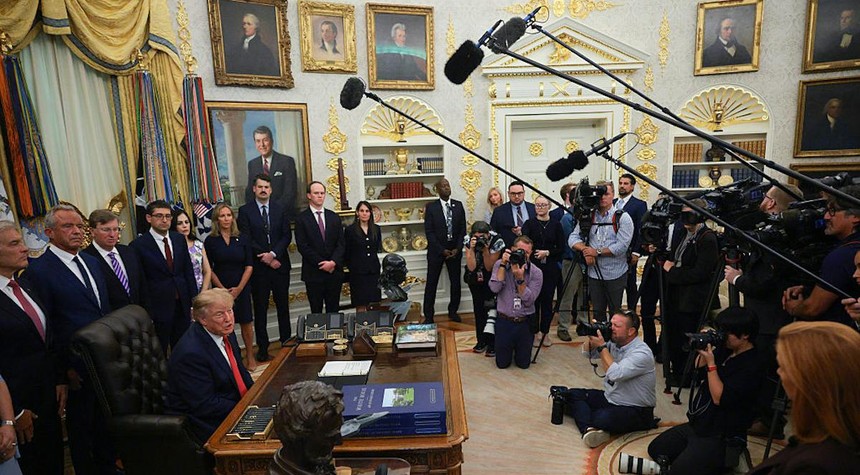
Here’s what you need to know about power and how it gets checked. A federal judge just told President Trump he can’t simply toss liberal news outlets out of the White House because he doesn’t like their coverage. Judge Timothy Kelly put a 14-day freeze on Trump’s ban of three outlets while the case moves forward. The irony? Kelly is a Trump appointee from his first term.
The White House wanted to keep out certain reporters by claiming national security concerns and labeling their work as fake news. Kelly wasn’t buying it. In his Thursday morning order, he wrote that the record lacks any real factual support for the idea that banning these outlets protects national security. You know what that means in plain English? The administration couldn’t back up its claims with actual evidence.
This isn’t Kelly’s first rodeo with Trump and media access. Back in 2018, he ruled in favor of CNN when the White House tried to boot Jim Acosta. The judge has a track record of following the law regardless of who appointed him, which is exactly how the system is supposed to work. Though it’s worth noting he also handed down a 22-year sentence to Proud Boys leader Enrique Tarrio for seditious conspiracy related to January 6, even though Tarrio wasn’t in D.C. that day.
The three outlets filed their lawsuit Monday arguing First Amendment violations. The White House fired back with a familiar argument that access to the White House is a privilege, not a right. They claimed these outlets published classified information and endangered national security. That’s a serious charge, but serious charges need serious proof.
Here’s where this gets interesting. The Trump administration’s filing argued the president has compelling interests in enforcing standards for journalists and protecting national security information. They even suggested the government can control reporter access to restricted areas for viewpoint-discriminatory reasons. Read that again. They’re essentially admitting they can kick out journalists based on their viewpoints if it happens in certain areas like the Oval Office.
The problem with that logic is it opens a door no president should walk through. If you can ban outlets for having the wrong viewpoint under the guise of security concerns, what stops any administration from clearing out all critical voices? The First Amendment exists precisely because our founders understood that government officials will always be tempted to silence critics.
Trump posted on Truth Social Monday that he’s not assaulting the free press but going after fake news, which he called a cancer that threatens national security. He even hinted more outlets might lose access soon. Look, nobody denies that media bias exists or that some reporting is sloppy or agenda-driven. But the solution to bad speech is more speech, not government censorship.
The conservative principle here matters more than the immediate politics. Limited government means the state doesn’t get to decide which journalists are legitimate based on whether their coverage is favorable. That’s a power we should never want any president to have, regardless of party. The marketplace of ideas works best when government keeps its heavy hands off the scales.
A preliminary hearing will happen before the two-week block expires. The case will likely drag on, as these things do. But the temporary restraining order sends a clear message that even a president can’t simply revoke credentials without due process. The outlets argued they were denied basic procedural fairness when their passes got pulled, and Kelly agreed they’d likely win on that claim.
This isn’t about defending liberal media outlets or their coverage. It’s about defending a principle that protects all of us. Today it’s outlets the right doesn’t like. Tomorrow it could be conservative journalists locked out by a Democratic administration using the same playbook. The rules have to apply equally or they don’t mean anything.
Related: Trump Task Force Finds $1.2 Billion in Suspected Fraud From Pandemic Contracts Nobody Was Watching