
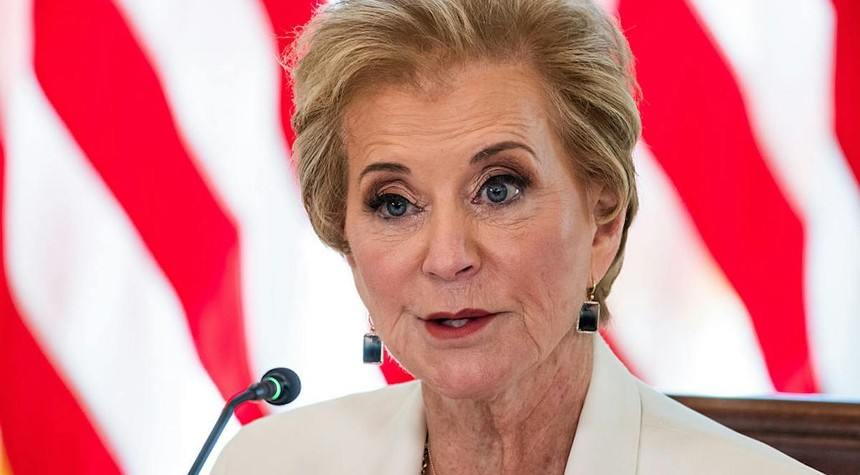
Linda McMahon is heading to Nashville this Wednesday with a message that’s been long overdue: American universities are broken, but they don’t have to stay that way. The Education Secretary plans to lay out what she’s calling a “course of renewal” for higher education, and she’s picked Vanderbilt University as her poster child for how things ought to be done.
Here’s what matters. McMahon inherited a mess. Decades of institutional rot have turned our campuses into places where free speech gets trampled, violent riots erupt over hurt feelings, and academic standards have fallen through the floor. These aren’t fringe problems anymore. They’re the norm at institutions that once represented the peak of American intellectual achievement.
But Vanderbilt did something different. While schools like Columbia and Penn needed federal settlement agreements to force them into basic sanity, Vanderbilt actually stepped up on its own. They issued a Declaration of Principles without anyone twisting their arm. That’s called leadership, and it’s rare enough these days to deserve celebration.
The declaration itself reads like common sense wrapped in formal language. It says universities exist to cultivate a free republic by creating and sharing knowledge through reason and evidence. You know, the stuff universities were supposed to be doing all along before they got distracted playing politics and coddling students who can’t handle disagreement.
McMahon’s prepared remarks connect this moment to something deeper than current campus chaos. She’s reaching back to the founding, reminding us that American higher education actually predates America itself. Colonial institutions were shaping minds and forging ideas before we ever declared independence. Those early students wrestled with Aristotle, studied law, debated biblical scripture, and built the intellectual foundations for human flourishing.
Think about what that means. The founders understood something we’ve forgotten: universities aren’t supposed to be daycare centers for overgrown children or indoctrination camps for progressive ideology. Jefferson and Franklin created these institutions to develop reasoned, moral, and yes, biblically grounded citizens who could sustain a republic.
The speech positions Vanderbilt as proof that reform isn’t just possible but happening right now. McMahon will call it a “national example” of renewal, praising the school for reclaiming what she describes as the “timeless pillars of truth, institutional neutrality, and open inquiry.” These aren’t radical concepts. They’re the basics that once made American universities the envy of the world.
What’s striking is McMahon’s framing of this as a tide rather than an isolated incident. She’s arguing that institutional leaders across the country are finally acknowledging they need to rebuild public trust and restore sanity. Some are doing it willingly, like Vanderbilt. Others need legal pressure. Either way, change is coming.
The timing matters too. Parents have watched their kids come home from college spouting nonsense they paid six figures to learn. Alumni have stopped donating because they don’t recognize their alma maters anymore. Employers complain that graduates can’t think critically or handle basic workplace disagreements. The higher education establishment burned through its credibility, and now it’s paying the price.
McMahon’s call to action extends beyond administrators. She’s urging courageous students and everyone who cares about truth to seize this moment. That’s the right instinct. Real reform won’t come just from the top down. It needs students willing to challenge groupthink, professors willing to teach instead of preach, and trustees willing to actually govern instead of rubber stamp whatever the faculty senate wants.
The question now is whether other universities will follow Vanderbilt’s lead or wait until they’re forced. McMahon is betting that this moment represents a genuine turning point, a chance to chart a new chapter in higher education. She might be right. The old model is collapsing under its own weight, and schools that adapt will thrive while the holdouts struggle.
American higher education can be saved. It just needs leaders willing to remember what these institutions were built for in the first place.
Related: The Washington Post Just Spent Resources Modeling Shadows to Attack Trump