The U.S. Navy just quadrupled a contract with Gecko Robotics to $300 million, and honestly, it tells you everything about where we are in the competition with China. We can’t outbuild them. Their shipyards are churning out vessels like assembly lines on caffeine while ours struggle with costs, delays, and the bureaucratic sludge that comes with any major defense project. So instead of pretending we’ll match Beijing hull for hull, we’re doing what Americans do best when our backs are against the wall. We’re getting smarter.
Jake Loosararian, the CEO of this Pittsburgh-based company, put it plainly. While China manufactures faster, America can outsmart them in how we maintain and operate what we’ve got. That’s not spin. That’s necessity dressed up as innovation. The original contract ceiling sat at $71 million just six months ago. The Navy looked at what these AI-powered robots could do and said we need more of this, right now.
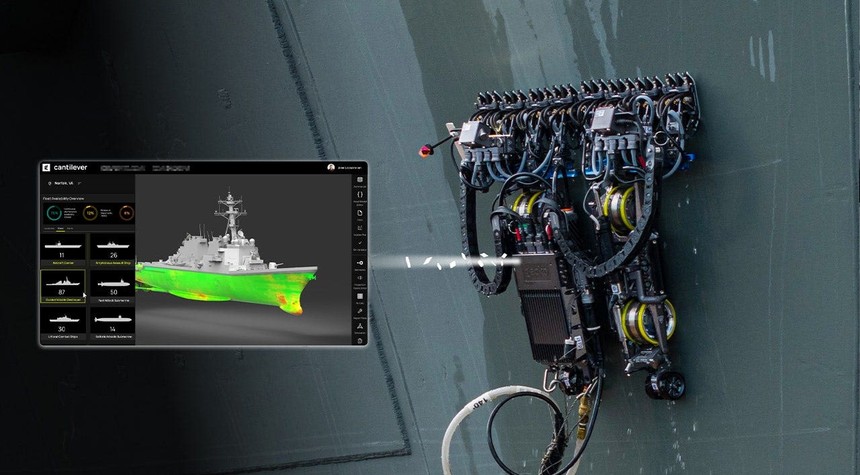
Here’s what Gecko’s technology actually does. Their robots crawl across warship hulls, flight decks, ballast tanks, all those tight spaces where human inspectors move slowly and carefully because one misstep means injury or worse. These machines scan for corrosion, metal loss, structural problems that could sideline a destroyer for months. The data gets fed into their Cantilever platform, which uses artificial intelligence to map out exactly what needs fixing. We’re talking about identifying structural issues up to 50 times faster than traditional methods. Saving up to $8 million in repair costs on a single ship. Those aren’t marketing numbers. Those are the kinds of figures that make admirals pay attention.
The new robot they’re rolling out, called Komodo, does something even more impressive. It can inspect the steel beneath those thick non-skid coatings on warship decks without stripping them away first. Think of it like a CAT scan for a ship. You get a complete picture of what’s happening underneath without tearing everything apart just to diagnose the problem. Traditionally, you’d have to remove all that deck coating before you even knew how bad the corrosion was. That means time, labor, materials, all spent before the actual repair work begins.
Loosararian shared an example that captures why this matters. One assessment initially called for repairs across roughly 1,200 square feet. After the robots did their scanning, that number dropped to about 300 square feet. You’re repairing less because you know exactly where the problem is. No guesswork. No safety margins that waste money and time. Just precision.
This approach matters because our fleet readiness has been a problem for years. Ships sit in maintenance longer than they should. Repairs cost more than projected. Meanwhile, China’s navy grows larger every year, and the gap widens. We’re not going to close that gap by suddenly building 50 new destroyers. The money isn’t there. The industrial capacity isn’t there. The political will to sustain that kind of shipbuilding program over decades definitely isn’t there.
But keeping the ships we have in fighting shape? Getting them through maintenance faster and back to sea where they belong? That’s achievable. That’s the kind of unglamorous, nuts-and-bolts work that doesn’t make for inspiring campaign speeches but wins the long game. Free market innovation solving a national defense problem. A private company in Pittsburgh developing technology that gives our sailors an edge.
The initial contract announced back in March had Gecko working on 18 ships in the Pacific Fleet. Destroyers, amphibious warships, littoral combat ships. Now with the ceiling pushed to $300 million, that work expands significantly. You don’t make that kind of investment unless the early results proved the concept works.
There’s something fundamentally American about this solution. We’re not trying to mimic China’s state-controlled shipbuilding apparatus. We’re leveraging private sector ingenuity, artificial intelligence, and good old-fashioned problem solving. Limited government shouldn’t mean weak defense. It means defense that’s smarter, leaner, more efficient. It means trusting American entrepreneurs to deliver solutions that bureaucracies never could.
China’s building ships faster, sure. But ships need maintenance. Their navy will face the same reality ours does. Steel corrodes. Systems break down. The question becomes who handles those challenges better. Who gets their fleet back to operational status faster when problems emerge. That’s where technology like this creates advantage.
The Navy’s decision to expand this contract so quickly shows they understand what’s at stake. Fleet readiness isn’t just about having ships. It’s about having ships that can actually sail, fight, and win when called upon. Every day a destroyer sits in drydock because inspections take too long is a day that ship can’t patrol the South China Sea or support our allies in the Pacific. Time matters. Efficiency matters. Results matter.
This is the kind of defense spending that actually makes sense. Not bloated contracts that drag on for decades. Not programs that cost billions before delivering a single operational unit. Just proven technology that solves a real problem, saves money, and gets our warships back where they need to be. That’s how you maintain a strong national defense without bankrupting the country. That’s how you compete with China without trying to become China.
Related: Houston Schools Finally Worked and Now Democrats Want to Destroy It All