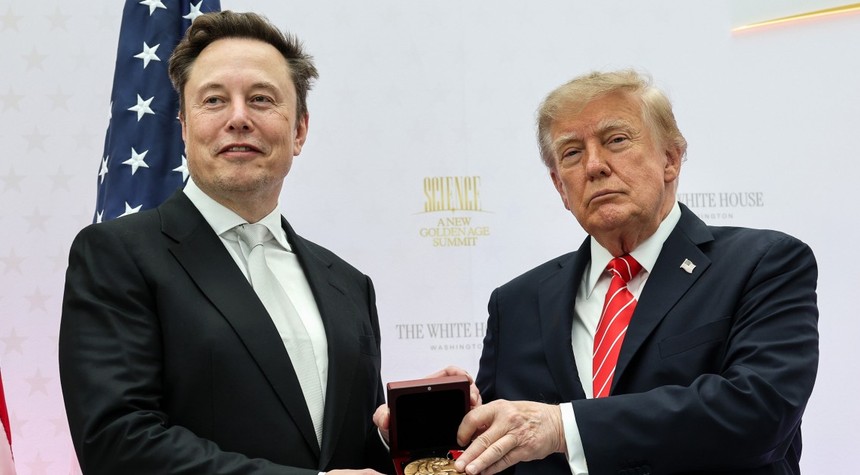
There’s something delicious about watching Donald Trump hand out National Medals of Science to the very tech titans the establishment spent years trying to villainize. Thursday’s Science: A New Golden Age Summit wasn’t just ceremony and handshakes. It was a statement about where real American innovation comes from, and spoiler alert, it’s not government committees or diversity consultants.
Elon Musk, Sergey Brin, Jensen Huang, and Lisa Su received National Medals of Science. Satya Nadella and Michael Dell walked away with National Medals of Technology and Innovation. These aren’t participation trophies. These are the people building the future while bureaucrats argue about pronouns in grant applications.
The irony wasn’t lost on anyone paying attention. Hours before Microsoft’s CEO stood on stage accepting his medal, Vice President JD Vance announced that the administration would suspend Microsoft and several other companies from a green card program for foreign workers. You want whiplash? That’s whiplash. But here’s the thing: both moves make sense if you understand what’s actually happening here.
The immigration conversation at this summit mattered more than the medals themselves. Jensen Huang, whose parents brought him to America chasing something better, told NBC News that receiving this honor “could only happen here in America.” He gets it. So does Carnegie Mellon University president Farnam Jahanian, who pointed out the uncomfortable truth that China cranks out more engineers and scientists than the U.S., Europe, and Japan combined.
We need the best minds here. Period. But we also need them coming through systems that serve American interests, not corporate labor arbitrage dressed up as innovation policy. The tension between honoring immigrant achievement and fixing broken worker visa programs isn’t contradiction. It’s grown-up governance.
Trump told the assembled crowd they’d “go down in the annals of history as being great.” He wasn’t wrong. These tech leaders have fundamentally reshaped how humans live, work, and connect. Nvidia’s chips power the AI revolution. Microsoft dominates enterprise computing. AMD keeps pushing semiconductor boundaries. Google organized the world’s information, for better and worse.
The summit built on Michael Kratsios’s July report about reinvigorating American scientific discovery. Kratsios, heading the Office of Science and Technology Policy, highlighted problems everyone knows exist but few admit: ballooning clinical trial costs, falling rates of novel drug approvals, scientific bureaucracy choking innovation like kudzu on a Georgia highway.
“We live in an age of American wonders and technological marvels, and with the help of the brilliant men and women here today, we will always be on top,” Trump said. Confidence like that drives progressives crazy because they’ve spent decades teaching Americans to apologize for excellence. But you know what? Confidence works. Belief in American exceptionalism isn’t jingoism when it’s backed by results.
The administration wants to streamline funding to promising scientists instead of routing everything through established channels that prioritize credentials over capability. That’s going to ruffle feathers in academia, where the grant-application industrial complex has become its own self-sustaining ecosystem. Good. Ruffle away.
Trump joked that the summit represented “an extremely high IQ audience, for a change.” The room chuckled. Critics will call it arrogance. But there’s honesty in acknowledging that gathering the people actually building tomorrow’s technology matters more than another congressional hearing where politicians perform for cameras.
The White House billed this as the start of a golden age in American science. Lofty language, sure. But walk through what these honorees have accomplished and the claim doesn’t seem so outlandish. We’re living through the fastest technological advancement in human history, and Americans are leading it.
The real test comes next. Will the administration follow through on cutting red tape? Will immigration policy actually attract top talent while protecting American workers? Will funding reforms empower brilliant researchers or just create new bottlenecks? Summits are easy. Execution is hard.
But Thursday sent a clear message: merit matters, innovation matters, and America intends to keep winning. In a political climate obsessed with equity over excellence, that’s not just refreshing. It’s necessary.
Related: The DOJ’s Sudden Interest in Cassidy Hutchinson Raises Questions Nobody Wants to Answer