
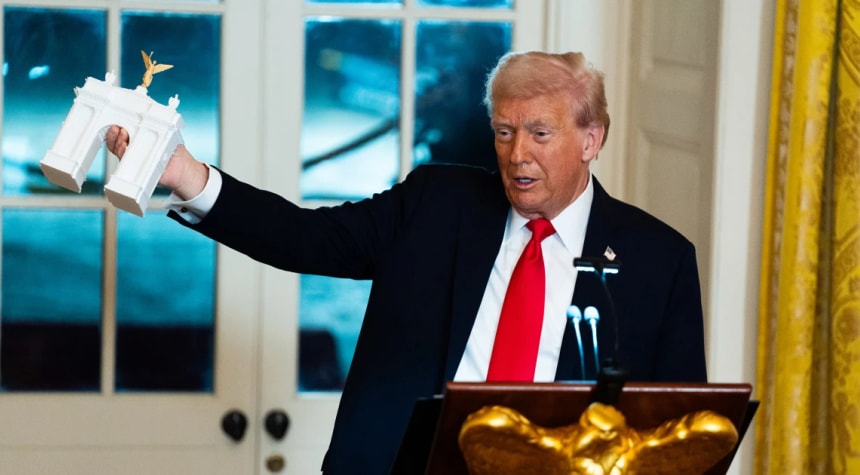
The National Capital Planning Commission is poised to approve President Trump’s ambitious Triumphal Arch project for Washington, D.C., setting up what will likely be a protracted legal battle over the 250-foot monument planned for Memorial Circle between the Lincoln Memorial and Arlington National Cemetery.
The commission, led by Trump appointees including Chairman Mark Paoletta, heard from approximately 130 public commenters Thursday before an expected vote. Paoletta, the Office of Management and Budget general counsel appointed to lead the commission in August, praised Trump’s "monumental vision" and called it a "national disgrace" that such a memorial had not already been constructed. According to Paoletta, the structure would be "the grandest arch ever built by mankind."
The facts are these. The arch would commemorate America’s 250th anniversary and, according to Trump, include military capabilities such as drones and snipers for enhanced national security. However, the final plans submitted to the commission conspicuously omit any mention of drones, ammunition storage, or sniper positions. When questioned about this discrepancy, Interior Department Deputy Chief of Staff Greg Wischer offered only that the design "is capable of hosting national security functions" while conveniently noting that specific details have been filed under seal in ongoing litigation.
This raises obvious questions about transparency and whether the administration is attempting an end-run around proper oversight.
Virginia and the District of Columbia have filed emergency legal action seeking to block construction, arguing the project violates at least five federal statutes. Most notably, they point to federal law limiting building heights in the District to 130 feet. The proposed arch would nearly double that limit at 250 feet. The jurisdictions also argue the project would disrupt traffic, harm the Potomac River environment, and require substantial resources to address negative impacts.
Preservationists and military veterans filed suit earlier this year, contending the project requires explicit Congressional authorization and that its location would obstruct the historic sight line between the Lincoln Memorial and Arlington National Cemetery. This sight line has existed for nearly a century and was designed to represent national unification following the Civil War. Vietnam War veteran Michael Lemmon, who served as U.S. ambassador to Armenia under the Clinton administration, testified that the arch is "frankly blasphemous."
The administration’s legal defense rests on a creative interpretation of century-old legislation. They argue that Congress authorized the project approximately 100 years ago when it approved 166-foot columns with statues for Memorial Bridge, columns that were never actually built. This argument is, to put it mildly, a stretch. The Memorial Bridge Act makes no mention whatsoever of an arch. Attorneys for Virginia and the District correctly characterize this defense as "implausible."
The administration also contends that Virginia and D.C. lack standing to sue, which ignores the obvious fact that the monument would sit directly at the border between these jurisdictions and would require both to expend resources managing its impacts.
U.S. District Judge Tanya Chutkan has requested notification following the commission’s vote. The opponents have specifically asked for an immediate halt to any construction, citing the administration’s previous destruction of the East Wing of the White House to build a ballroom, after which the administration argued that stopping construction would harm the government and pose security risks.
Whether this monument represents appropriate commemoration of America’s 250th anniversary or executive overreach will ultimately be decided in federal court. What is clear is that ramming through a massive construction project over the objections of local governments, veterans groups, and preservationists while hiding security details under seal is not the proper way to honor American democracy.
Related: Hegseth Demands $350 Billion While Brushing Off Impeachment Theater