
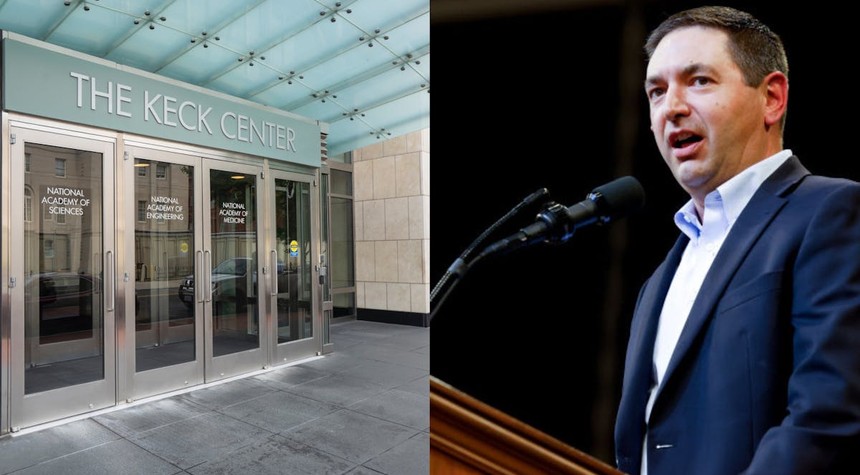
More than a dozen Republican attorneys general are demanding that the National Academy of Sciences remove a politically biased climate change chapter from its official manual, raising serious questions about the misuse of taxpayer dollars to advance partisan agendas.
Montana Attorney General Austin Knudsen sent a letter to National Academy of Sciences President Marcia McNutt on Thursday insisting she “take action” to remove a section on “climate science” from the “Reference Manual on Scientific Evidence: Fourth Edition.” The manual serves as a handbook for federal judges, which means the stakes could not be higher for ensuring objectivity.
Here are the facts: The chapter was authored by two leftist activists who have publicly advocated for ending the use of fossil fuels. This is not speculation or inference. These are documented positions taken by the authors in their professional capacities.
“This partisanship is especially troubling since taxpayer money provided by the federal government is the largest source—more than $200 million—of the National Academies’ budget,” the attorneys general wrote. “Taxpayer money should not be used for political causes, particularly by an entity that Congress created to provide independent and objective scientific reports.”
The logic here is straightforward: If Congress established the National Academy of Sciences to provide independent and objective scientific reports, then allowing partisan activists to author chapters in judicial handbooks represents a fundamental betrayal of that mandate.
The manual was co-produced by the National Academy of Sciences, Engineering, and Medicine with the Federal Judicial Center. Earlier this month, the judicial center removed the climate chapter from its version after more than two dozen Republican attorneys general warned it could improperly influence judicial decisions. The National Academy of Sciences should follow suit immediately.
Consider the backgrounds of the chapter’s authors. Jessica Wentz, a fellow at Columbia Law School’s Sabin Center for Climate Change Law, co-authored the chapter. In an amicus brief opposing an oil drilling project in Alaska, Wentz wrote that “the world needs to phase out fossil fuels as rapidly as possible in order to avert potentially catastrophic levels of global warming and climate change.” That is an advocacy position, not objective science.
The other co-author, Radley Horton, a professor at Columbia University’s Climate School, has previously trained judges on climate litigation. He has stated that “it’s absolutely critical that there be a global effort to do everything we can to dramatically draw down emissions.” Again, this is activism, not dispassionate scientific analysis.
The situation becomes even more problematic when examining those acknowledged in the chapter. Michael Burger, who is currently representing Honolulu in litigation against energy companies, received acknowledgment. So did Michael Gerrard, who has openly advocated for “decarbonization” through climate-related lawsuits.
This represents a clear conflict of interest. Individuals actively engaged in climate litigation are being positioned as objective authorities in a manual designed to educate federal judges who may preside over similar cases. The circular reasoning is obvious: activists write the manual, judges read the manual, activists litigate before those judges.
The broader principle at stake extends beyond climate policy. When taxpayer-funded institutions created to provide objective scientific guidance instead become vehicles for partisan advocacy, they undermine public trust in both science and government institutions. The National Academy of Sciences receives over $200 million annually from federal taxpayers. Those taxpayers deserve better than political pamphleteering masquerading as scientific consensus.
The solution is simple: Remove the chapter, as the Federal Judicial Center has already done, and restore the manual to its intended purpose as an objective scientific resource.
Related: Rubio Conducts Backchannel Talks With Castro’s Grandson as Cuban Regime Teeters