
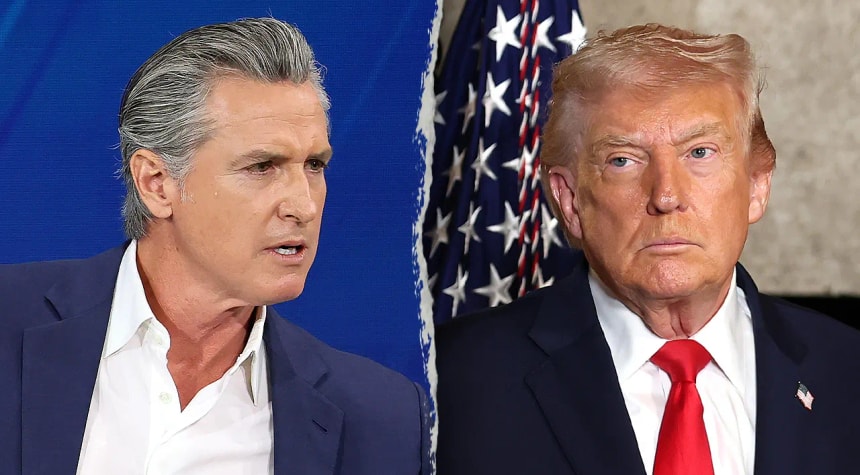
President Donald Trump will directly challenge California Governor Gavin Newsom over his sweeping proposal to commute the sentences of 548 death row inmates, a plan that would spare some of the most heinous killers in American criminal history from execution. The facts here are straightforward and deeply disturbing.
Trump is set to appear Monday afternoon at the Department of Justice alongside Attorney General Todd Blanche and FBI Director Kash Patel to condemn the Democratic governor’s proposed commutations. Among those who would benefit from Newsom’s clemency are Marcus Wesson, who murdered nine members of his own family, Richard Allen Davis, who kidnapped and killed 12-year-old Polly Klaas, and Isauro Aguirre, convicted of torturing 8-year-old Gabriel Fernandez to death.
Families of murder victims are expected to attend the event, where their stories will receive the attention that Newsom’s administration has apparently failed to provide. White House spokeswoman Lauren Bis stated the obvious when she said that "Governor Newsom is failing the victims and their families by refusing to carry out justice against these barbaric child killers and serial killers."
Let us be clear about what Newsom announced on November 5. He intends to commute all 548 California death sentences to life imprisonment without parole, arguing that capital punishment is incompatible with the state’s values. This raises an immediate logical question: whose values, exactly? California voters rejected efforts to abolish the death penalty in both 2012 and 2016. The voters have spoken twice on this issue, and twice they have disagreed with Newsom’s supposed assessment of their values.
Newsom’s response to this contradiction is revealing. He acknowledged that California voters have chosen to keep the death penalty but invoked his clemency authority to override their judgment. He claimed that "the constitution also gave every governor clemency authority, and that power exists for moments when law as applied cannot be squared with justice." This argument is fundamentally flawed. The voters determined what justice requires in these cases. Juries heard the evidence, prosecutors made their arguments, and the legal system reached its conclusions through the democratic process.
The list of criminals who would benefit from this clemency is a catalog of evil. Charles Ng was convicted of 11 murders involving captivity, torture and sexual violence. Randy Kraft, the so-called "Scorecard Killer," was convicted of murdering 16 men in crimes involving sexual assault and mutilation. Chester Turner was convicted of murdering 14 women in Los Angeles. These are not cases involving ambiguous evidence or questions about guilt. These are monsters.
Some cases involved the systematic slaughter of entire families. Ramon Salcido killed seven people during a Sonoma County rampage, including his wife and two young daughters. Vincent Brothers, a former school administrator, murdered his wife, three children and mother-in-law in Bakersfield. The brutality here defies comprehension, and yet Newsom believes that executing these killers cannot be squared with justice.
California prosecutors and victims’ advocates are mounting significant opposition. San Luis Obispo County District Attorney Dan Dow stated that he was "sickened, frankly, for the crime victims in California who were slapped in the face by our governor." Orange County District Attorney Todd Spitzer accused Newsom of extending "mercy for the wolves while inflicting the ultimate act of cruelty on the sheep."
The legal battle has intensified. Under California law, 382 of these commutations require a recommendation from the state Supreme Court because the inmates have multiple felony convictions. A coalition of California prosecutors and victims’ advocates has asked the state Supreme Court to halt the plan, arguing that Newsom failed to provide victims and their families an opportunity to be heard before pursuing this sweeping clemency action.
The court has invited additional briefs and is considering the governor’s request. Newsom has asked the justices to act before his term ends in January, suggesting he understands the political volatility of his decision and wants to insulate himself from accountability.
This case illustrates a fundamental divide in American politics. On one side are those who believe that justice demands consequences proportional to crimes, that democracy requires respecting voter decisions, and that victims’ families deserve consideration in clemency decisions. On the other side are those who believe their moral intuitions should override democratic processes and established law.
The Trump administration is correct to intervene. California has not carried out an execution since 2006, and Newsom imposed a formal moratorium during his governorship. But there is a significant difference between declining to execute sentences and permanently eliminating them through mass clemency. The former represents prosecutorial discretion. The latter represents contempt for the democratic process and the families who fought for years to see justice done.
Related: Trump Administration Admits Wrongful Deportation of US Citizen After Months of Denial