
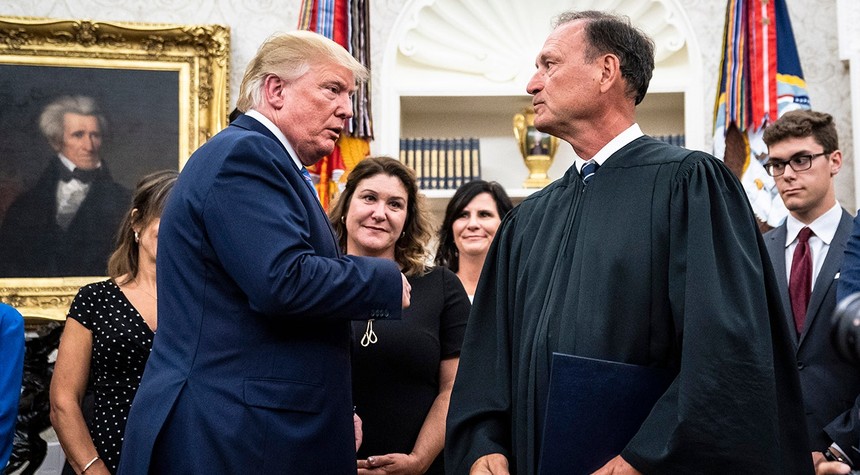
The Supreme Court has temporarily blocked President Donald Trump from deploying National Guard forces to Chicago in a 6-3 decision that raises serious questions about executive authority and the protection of federal officers. Justice Samuel Alito issued a scathing dissent that exposes the logical inconsistencies in the majority’s reasoning.
Here are the facts. President Trump invoked rarely used federal authority to federalize approximately 300 National Guard members for deployment to Chicago. The stated purpose was straightforward: protect federal immigration officers from violent protesters who were obstructing, assaulting, and threatening ICE personnel attempting to execute their lawful duties.
The Trump administration’s position rests on a simple premise. Illinois Governor JB Pritzker and local Democratic leadership have actively resisted federal immigration enforcement. When protesters attacked federal officers, state and local law enforcement failed to adequately respond. The National Guard deployment was necessary because state authorities refused to fulfill their basic obligation to maintain order and protect federal personnel.
Illinois sued, and lower courts blocked the deployment. Their reasoning hinged on statutory language requiring the president to be “unable with the regular forces to execute the laws of the United States” before deploying National Guard troops. The Supreme Court upheld these lower court decisions while the case continues.
The majority opinion, unsigned, determined that “regular forces” means the United States military, not ICE or civilian law enforcement agencies. According to this interpretation, Trump would need to justify deploying actual military forces for domestic law enforcement purposes before exhausting that option and turning to the National Guard.
This is where the logic breaks down entirely.
Justice Alito, joined by Justice Clarence Thomas, demolished this reasoning in his dissent. Alito correctly identified that the majority embraced an “eleventh-hour argument” about the meaning of “regular forces” without adequate consideration. More fundamentally, Alito argued that the Court failed to give proper deference to the president’s determination that agitators were preventing federal officers from performing their duties and that National Guard assistance was necessary.
“Whatever one may think about the current administration’s enforcement of the immigration laws or the way ICE has conducted its operations, the protection of federal officers from potentially lethal attacks should not be thwarted,” Alito wrote.
He is absolutely correct. The majority’s decision was both unwise and imprudent.
Consider the practical implications. The Court’s interpretation creates an impossible standard. The president must apparently deploy the full United States military for domestic law enforcement before he can use National Guard forces, even when state authorities are actively undermining federal law enforcement. This makes no logical sense and creates a dangerous precedent that hamstrings executive authority precisely when federal officers face genuine threats.
Justice Neil Gorsuch issued a separate dissent, indicating additional constitutional concerns with the majority’s approach.
The underlying issue remains unresolved. Federal immigration officers face violent opposition in sanctuary jurisdictions where Democratic governors and mayors have made resistance to federal immigration enforcement a centerpiece of their political identity. When protesters attack federal officers and state authorities refuse to intervene, what recourse does the president have?
According to six Supreme Court justices, apparently not much. The decision prioritizes creative statutory interpretation over the fundamental responsibility to protect federal personnel executing lawful duties. This is judicial activism dressed up as textualism, and it undermines both executive authority and the rule of law.
Related: Supreme Court Splits on National Guard Deployment as Chicago Descends Into Chaos