
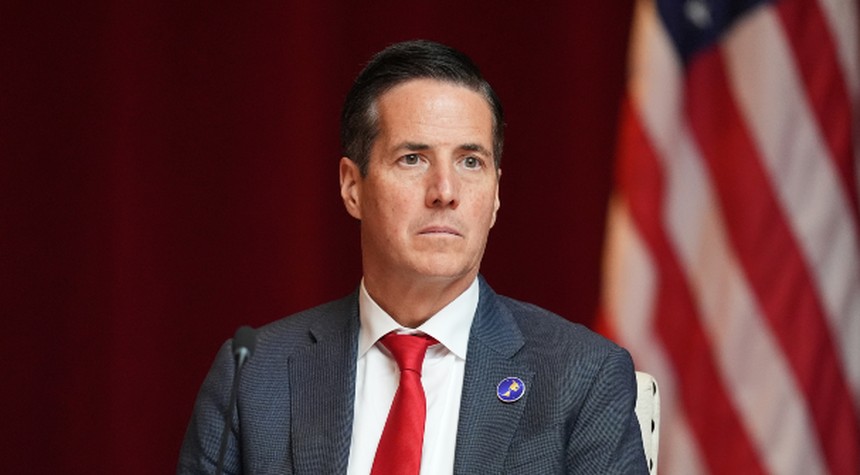
Chinese state media is having an absolute meltdown over Senator Bernie Moreno’s proposal to expand restrictions on Chinese vehicles, and honestly, their reaction tells you everything you need to know about why we need this ban in the first place.
The Ohio Republican laid it out plain this week. No Chinese autos on American roads. Period. His proposed legislation would toughen existing restrictions on Chinese automakers, and predictably, Beijing’s propaganda machine kicked into high gear faster than one of their surveillance-equipped electric vehicles.
The state-run Global Times trotted out their usual cast of “experts” to explain why Americans should just accept Chinese cars flooding our market. They claim the ban would be difficult to implement because global supply chains are so interconnected. You know what? That’s exactly the problem. We’ve spent decades letting China weave itself into every corner of our economy, and now they’re acting shocked when we finally decide to protect our interests.
Here’s the thing about national security that Beijing doesn’t want you thinking about too hard. Every Chinese vehicle is a potential rolling surveillance device. We’re not being paranoid. We’re being realistic about a regime that has repeatedly demonstrated its willingness to exploit technology for espionage and control. The Chinese Communist Party doesn’t do anything without strings attached, and those strings lead straight back to Xi Jinping.
Zhou Mi, some senior research fellow at the Chinese Academy of International Trade and Economic Cooperation, accused the U.S. of “overstretching the concept of security.” That’s rich coming from a country that bans American social media platforms, restricts foreign companies at every turn, and literally has laws requiring Chinese firms to cooperate with state intelligence operations. They want unrestricted access to our markets while maintaining an economic fortress around their own.
The Chinese embassy in Washington piled on too, whining about trade protectionism and discriminatory policies. They invoked the sacred principles of market economy and fair competition with apparently zero sense of irony. China lecturing anyone about fair competition is like a card shark complaining about being kicked out of the casino.
Let’s talk about those survey results the Global Times keeps waving around, the ones showing nearly half of American consumers think Chinese cars offer excellent value. Sure, they’re cheap. That’s the whole point. China subsidizes its industries to undercut competitors, captures market share, then dominates entire sectors. We’ve watched this playbook run in solar panels, steel, and countless other industries. The initial bargain becomes a long-term strategic disaster.
This isn’t about being afraid of competition. American automakers can compete with anyone when the playing field is actually level. This is about recognizing that economic policy and national security aren’t separate concerns anymore, if they ever were. China views commerce as warfare by other means, and we’d be fools to pretend otherwise.
The timing of Beijing’s outrage is interesting too. President Trump is scheduled to meet with Xi in May, and suddenly Chinese state media is cranking up the pressure, trying to paint reasonable security measures as radical protectionism. They’re attempting to set the narrative before negotiations even begin.
Senator Moreno gets it. Sometimes the right policy isn’t complicated. You identify a threat, you address it directly. No Chinese vehicles on American roads means no Chinese surveillance equipment rolling through our neighborhoods, no data harvesting our driving patterns, no kill switches controlled by a hostile foreign power. It means protecting American workers and American security simultaneously.
The Chinese government’s furious response should reassure us we’re on the right track. When Beijing screams this loud about a policy proposal, it usually means that proposal threatens something they value. Good. It’s about time we stopped worrying so much about offending a regime that shows zero concern for our interests.
Related: Ketanji Brown Jackson’s Wallet Analogy Just Redefined American Citizenship