
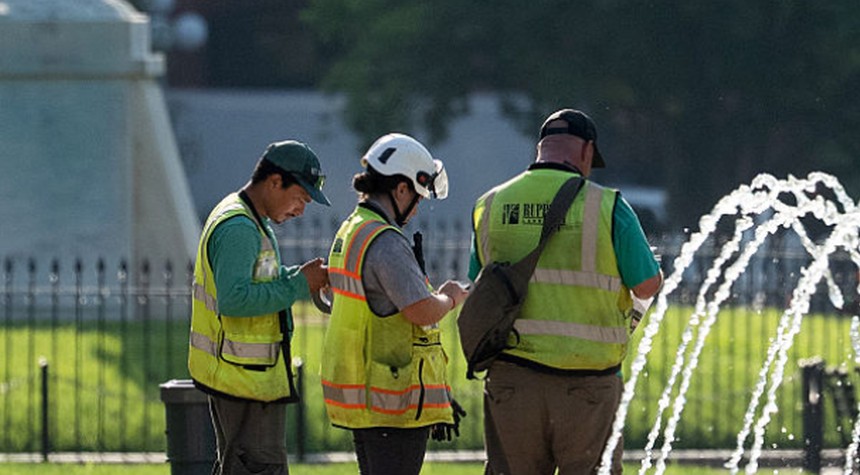
There’s something refreshingly straightforward about planting trees to match your presidential number. President Trump wants to add maple trees to Lafayette Square near the White House, bringing the total count to 47. It’s the kind of symbolic gesture that critics will mock and supporters will appreciate, which pretty much sums up everything about this administration.
The Washington Post got wind of the plan from two anonymous sources, because apparently nobody in D.C. can just say things on the record anymore. The park already has several dozen trees, though some came down during renovations. We don’t know yet how many new maples Trump will add or whether existing trees will get the axe to hit that magic number. Nothing’s final until the president announces it himself, which tracks with how he micromanages these design projects.
Trump visited the park over the weekend to inspect renovation progress across the capital. “I just returned from a tour of various Statues, Monuments, Fountains and, most importantly, an old and run down Golf Course located throughout Washington, D.C., our Nation’s Capital,” he wrote Sunday. The man can’t resist throwing in a golf course reference, even when he’s talking about national monuments. That’s authenticity, whether you like it or not.
Here’s what matters beyond the tree count. This isn’t just about optics or vanity projects. The broader initiative to restore D.C.’s monuments and public spaces ahead of America’s semiquincentennial celebration represents something we’ve lost in recent years: the idea that our national symbols deserve respect and maintenance. You know what’s radical these days? Believing that graffiti-covered monuments and homeless encampments surrounding our nation’s most important historical sites shouldn’t be the accepted norm.
Interior Secretary Doug Burgum told Breitbart News Daily that “beauty is a choice.” He’s right. Under Trump’s leadership, the National Park Service has removed 152 homeless camps from D.C.’s pocket parks, circle parks, and triangle parks. The Columbus fountain was literally a homeless encampment 16 months ago. Now it’s restored. Meridian Hill Park’s cascading fountain hadn’t worked for decades and was surrounded by overgrowth and more homeless camps. Now it functions again.
This is where the left loses the plot entirely. They’ll frame this as heartless, as if pointing out that our capital city looked like a neglected disaster zone somehow means you don’t care about struggling Americans. That’s garbage logic. You can address homelessness with actual solutions while simultaneously refusing to accept that our monuments should be covered in spray paint and our parks turned into open-air drug markets. These aren’t competing values.
The choice between squalor and beauty isn’t a budget question or a resource allocation problem. It’s a leadership question. Previous administrations accepted the decline because fixing it required making decisions that might draw criticism. Trump doesn’t operate that way. He sees something run down and says fix it. Revolutionary concept in modern Washington.
Burgum nailed it when he said leadership is a choice. So is living in beauty versus living in squalor. For years we watched D.C. deteriorate while politicians shrugged and said there wasn’t money or political will to address it. Turns out there was plenty of both. Someone just needed to care enough to make it happen.
The 47 trees might seem like a small thing, maybe even a vanity project to some. But it’s part of a larger pattern of actually giving a damn about how our nation’s capital looks as we head into our 250th anniversary. That matters. Symbols matter. How we maintain and present our history matters. Pretending otherwise is how we ended up with graffiti-covered statues and broken fountains in the first place.
Related: The FTC Firing That Just Rewrote Presidential Power for Good