
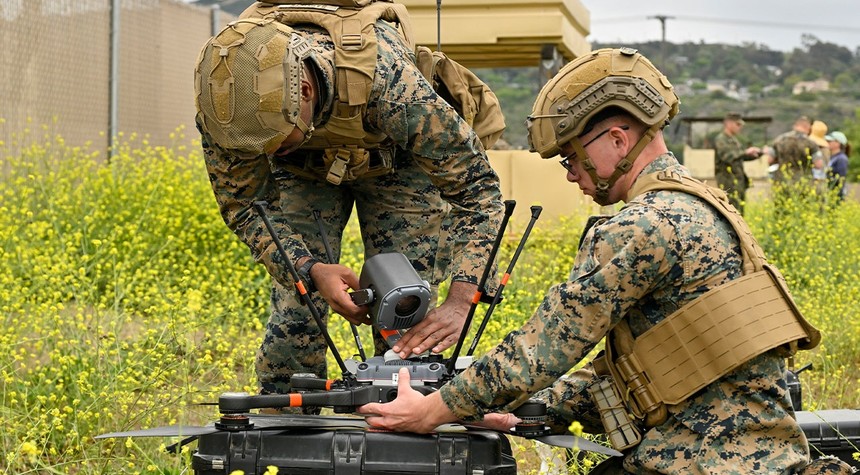
The Pentagon announced Wednesday it’s doing something that should have happened years ago. They’re consolidating all military drone and autonomous systems oversight under one office, reporting directly to Deputy Secretary of War Stephen Feinberg. This isn’t bureaucratic reshuffling for the sake of it. This is the Department of War admitting that our adversaries are eating our lunch while we’ve been stuck in committee meetings.
Here’s the reality that should terrify you. Our enemies are collectively producing millions of unmanned systems every year. Millions. While we’ve been debating acquisition processes and splitting oversight between the Defense Innovation Unit, Joint Interagency Task Force 401, and a half dozen other alphabet soup agencies, China and others have been flooding the zone. They’ve figured out what Ukraine learned in real time: drones are the future of warfare, and whoever fields them fastest and cheapest wins.
The newly minted Direct Reporting Portfolio Manager for Unmanned Systems will oversee everything from land to sea to air domains. That means funding, acquisition, and policy that used to be scattered across military branches will now answer to one person. You know what that sounds like? Efficiency. The kind of streamlined decision-making that happens in the private sector every day but somehow becomes revolutionary when government tries it.
Chief Pentagon Spokesman Sean Parnell nailed it when he called drones and autonomous systems “the most consequential battlefield innovation of this generation.” That’s not hyperbole. We’re watching warfare transform before our eyes, and the lesson from Ukraine couldn’t be clearer. Mass matters. When you can field thousands of cheap drones instead of a handful of expensive platforms, you change the calculus of combat entirely.
Speaking of cheap, Allen Control Systems just unveiled something called Bullfrog. It’s an AI-powered autonomous defense system that can neutralize drone swarms for ten dollars per kill. Ten dollars. Compare that to current missile interceptors that cost hundreds of thousands or millions per shot. This is the kind of innovation that happens when you let free-market capitalism and genuine security needs collide without bureaucratic interference gumming up the works.
The uncomfortable truth is that we’re playing catch-up. Global military drone production has skyrocketed over the last three years while we’ve been moving at the speed of Pentagon procurement, which is to say glacially. This reorganization signals that someone finally understands we need to move at the speed the moment demands, not the speed our acquisition regulations prefer.
Limited government doesn’t mean weak government. It means focused government. Consolidating drone oversight isn’t about creating another bloated office. It’s about eliminating redundancy and empowering decisive action. When you’re facing adversaries who can pivot and produce at scale, you can’t afford seventeen different offices with overlapping mandates and competing priorities.
The strategic edge we’ve enjoyed for decades isn’t guaranteed. It requires constant innovation, rapid fielding of new capabilities, and the willingness to reorganize when the old way isn’t working. This move suggests the Trump administration gets that. Whether it’s enough, whether it’s fast enough, remains to be seen. But standing still was never an option.
Related: Border Smugglers Used Drug-Laced Candy on Children as Young as Five