
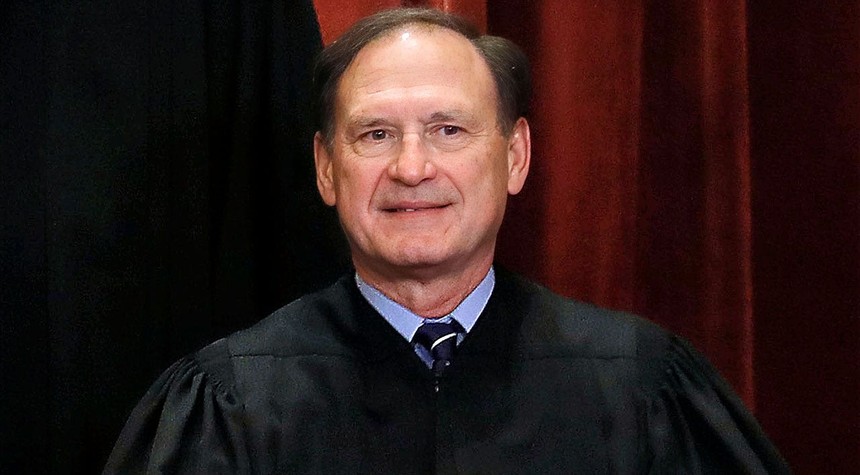
Justice Samuel Alito just did what too few in Washington have the spine to do. He called out nonsense when he saw it.
During oral arguments Tuesday, the Supreme Court heard a case that could fundamentally reshape how America handles asylum claims at the border. The question sounds technical, but it’s anything but. Can migrants stopped at a port of entry on the Mexican side of the border claim they’ve “arrived in” the United States and therefore qualify for asylum protections? The Ninth Circuit, that bastion of creative jurisprudence, said yes. The Trump administration said absolutely not. And now the highest court in the land has to sort through this mess.
Enter Kelsi Corkran, attorney for the asylum seekers, who offered an argument so slippery it could’ve been coated in oil. She claimed that “arriving at” and “arriving in” mean essentially the same thing. The only difference, she suggested, is grammatical. Just a tiny preposition. Nothing to see here.
Alito wasn’t buying it. And honestly, neither should anyone with a functioning grasp of the English language.
“Do you think someone who comes to the front door and knocks at the door has arrived in the house?” Alito asked. It’s the kind of question that cuts through the fog of legal doublespeak and lands squarely in common sense territory. The person may have arrived at the house, sure. But arrived in it? That’s a different matter entirely.
Corkran’s response was telling. She pivoted to verb tenses, suggesting the real issue was whether we’re talking about past or present action. You know what that is? That’s what lawyers do when they’re cornered. They shift the terrain, muddy the waters, hope you’ll forget the original question.
This isn’t just about grammar. It’s about sovereignty. It’s about whether America still has the right to control who enters its territory and under what conditions. The distinction between “at” and “in” isn’t some pedantic exercise in linguistic philosophy. It’s the difference between maintaining a border and effectively erasing it.
The broader context here matters. We’re living through an era where multiple naturalized citizens have been accused of serious crimes, including mass shootings. Gene Hamilton from America First Legal has been making the rounds discussing how naturalization reform might prevent some of these tragedies. The connection isn’t incidental. When you blur the lines on who gets to enter and stay in this country, when you treat border enforcement as optional, you’re not being compassionate. You’re being reckless.
The left has spent years redefining terms to suit their policy preferences. “Undocumented workers” instead of illegal aliens. “Arriving in” instead of “arriving at.” These aren’t innocent word choices. They’re strategic maneuvers designed to shift the Overton window, to make enforcement seem cruel and borders seem arbitrary.
But borders aren’t arbitrary. They’re the foundation of national sovereignty. Every nation on earth maintains them, enforces them, defends them. The idea that someone physically standing in Mexico has somehow “arrived in” the United States because they’re at a port of entry would be laughable if the implications weren’t so serious.
The Supreme Court’s eventual ruling will determine how officials handle future surges at the border. If the Ninth Circuit’s reasoning stands, we’re essentially telling the world that showing up at our doorstep is the same as being invited inside. That’s not asylum law. That’s open borders with extra steps.
Alito’s questioning revealed what happens when someone refuses to play along with semantic games. He exposed the emptiness of arguments built on linguistic sleight of hand rather than legal principle. The attorney representing asylum seekers had to know her position was weak. That’s why she resorted to claiming prepositions don’t matter, that grammar is just grammar.
Except grammar does matter. Words have meanings. “At” and “in” describe different spatial relationships for a reason. A package arrives at your door. A guest arrives in your home. The distinction is clear to anyone not trying to lawyer their way around it.
This case will have consequences that ripple far beyond the immediate parties involved. It will shape how America approaches border security, asylum processing, and immigration enforcement for years to come. The stakes couldn’t be higher. And that’s precisely why Alito’s refusal to accept word salad as legal argument matters so much.
We need more of this. More willingness to challenge bad arguments regardless of how they’re dressed up in legalese. More insistence that words mean what they’ve always meant. More defense of common sense against the forces that would complicate it into oblivion.
Because once you accept that “at” and “in” are interchangeable, you’ve accepted that language itself is negotiable. And if language is negotiable, so is law. So is sovereignty. So is everything.
Related: Soros-Funded Prosecutor Threatens to Handcuff ICE Agents Doing TSA’s Job