
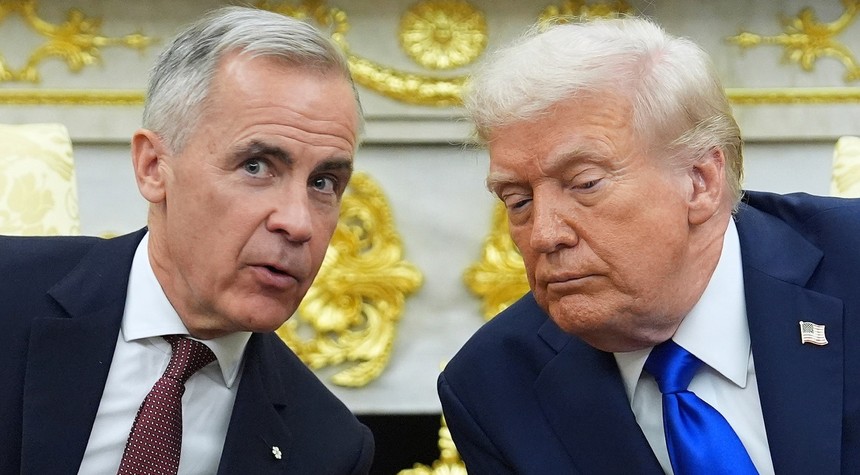
Trump just turned the screws on Canada, and honestly, it’s hard to see what choice he had left. The president announced Monday that he’s doubling tariffs on Canadian cars, auto parts, steel, and trucks to 50 percent starting New Year’s Day 2027. The move comes after trade negotiations collapsed over the weekend, with both sides walking away from the table empty-handed and irritated.
Here’s what happened. Canada’s Prime Minister Mark Carney stood before cameras Saturday and complained that American negotiators “asked too much and offered too little.” That’s diplomatic speak for we didn’t get our way. Carney went on to criticize the U.S. for using “economic integration as a weapon,” which is rich coming from a country that’s built its entire modern economy on the back of American consumer demand and supply chain integration.
Let’s be clear about something. The U.S. exported $175.8 billion in goods to Canada in the first half of 2026 alone. That makes Canada our second-biggest export partner after Mexico. That’s substantial. But you know what else is substantial? The leverage that gives us. Canada needs access to American markets far more than we need theirs, and pretending otherwise is just political theater designed for domestic consumption up north.
Trump put it bluntly on his social media platform. “WE DON’T NEED CANADA, THEY NEED US!” It’s not elegant, but it’s accurate. The Canadian economy is deeply intertwined with ours by design and by geography. They can huff and puff about retaliatory tariffs all they want, and Carney promised to match us “dollar for dollar” with roughly $28 billion in counter-tariffs coming September 8. But let’s do the math here. When you’re in a trade fight and one side has significantly more economic firepower, the outcome isn’t really in doubt.
The timing is interesting too. Trump’s delaying the new 50 percent rates until January 2027, giving both sides several months to reconsider their positions. That’s not weakness. That’s strategy. It’s a window for Canadian negotiators to come back with something reasonable instead of the entitled attitude they’ve been showing. Because that’s really what this comes down to, isn’t it? Carney and his team walked into negotiations expecting concessions, expecting America to bend on automobile tariff structures that would have slowly hollowed out our own manufacturing base over time.
Traditional conservatives understand something crucial about trade. It’s not inherently good or bad. It’s a tool, and like any tool, it needs to serve American interests first. The post-Cold War consensus treated free trade as an unquestionable moral good, a kind of economic religion where questioning the orthodoxy made you a heretic. But that consensus cost us millions of manufacturing jobs, gutted entire communities, and left us dependent on countries that don’t share our values or interests.
Canada likes to position itself as our friendly neighbor, the polite folks to the north who share our values and history. And in many ways, they are. But friendship doesn’t mean we ignore our own economic interests or let them take advantage of arrangements that were negotiated decades ago under completely different circumstances. The world changed. China rose. Supply chains shifted. Energy markets transformed. Pretending we should operate under 1990s assumptions in 2026 is absurd.
What Carney calls weaponizing economic integration, others might call finally waking up to economic reality. For years, American politicians treated trade negotiations like charity work, giving away leverage for vague promises of goodwill and partnership. That approach built the current mess where allies feel entitled to favorable terms regardless of whether those terms actually benefit American workers and businesses.
The 50 percent tariff on cars and steel sends a message beyond just Canada too. It tells every trading partner that the era of one-sided deals is over. Mexico is watching. The European Union is watching. China is definitely watching. They’re all calculating whether their own trade arrangements might need renegotiating, and whether pushing back against American demands is worth the economic pain that might follow.
Critics will say this approach risks alienating allies and damaging relationships we’ve spent decades building. Maybe. But what good are alliances where the terms consistently disadvantage us? What’s the point of relationships where bringing up legitimate grievances gets you labeled a bully? Real partnerships involve give and take, not just American giving while everyone else takes.
Trump’s approach isn’t subtle, and it certainly isn’t diplomatic in the traditional sense. But it’s producing results that decades of careful diplomatic language never achieved. Sometimes you need to be willing to walk away from the table. Sometimes you need to impose real consequences to get serious negotiations. Canada will survive 50 percent tariffs. Their economy will adjust, their industries will adapt, and their negotiators will probably come back with better offers.
The question isn’t whether Trump’s being too aggressive. The question is why it took this long for an American president to actually defend American economic interests without apologizing for it.
Related: New York Taxpayers About to Get Fleeced Twice by Mamdani’s Grocery Store Fantasy